
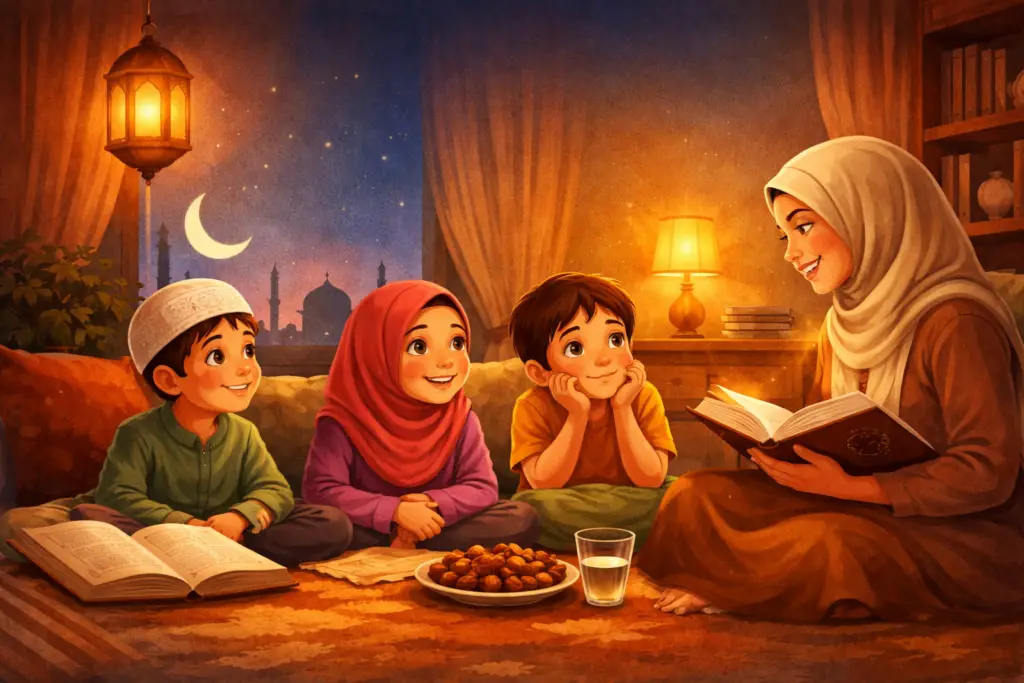
Ramadan has a unique way of transforming homes.
Children wake up early for suhoor with sleepy smiles, fast (or try to), listen to stories of the Prophets, and eagerly wait for iftar. For 30 days, their routines shift, their awareness of faith deepens, and their connection with Allah feels real — even at a young age.
And then, suddenly, it ends.
Eid arrives with joy, celebration, and family gatherings. But within a few days, many parents begin to notice something familiar: the routines fade, the excitement settles, and slowly, children drift back to old habits — more screen time, less reflection, and weaker engagement with faith.
If you’ve seen this happen, you’re not alone.
The real challenge isn’t building momentum in Ramadan — it’s sustaining it after Ramadan, especially for children between the ages of 5 and 12.
So how do we keep that Ramadan spirit alive in a way that feels natural, enjoyable, and sustainable for kids?
Why the Ramadan Effect Fades So Quickly
Ramadan works because it creates an environment.
There’s structure, community, repetition, and meaning. Children aren’t just told what to do — they experience it daily. But after Eid, that structure disappears overnight.
Expecting children to maintain the same level of discipline without that environment is unrealistic.
Instead of trying to “force” Ramadan habits year-round, the goal should be simpler:
Preserve the essence of Ramadan in small, consistent ways.
Check out: Islamic children books (Ages 5-12)
1. Focus on Small, Repeatable Habits (Not Big Changes)
One of the biggest mistakes parents make is trying to maintain everything at once — daily Quran, duas, fasting, prayers, and more.
For a child, that quickly becomes overwhelming.
Instead, choose 2–3 small habits:
- A short daily dua before sleeping
- Saying “Bismillah” consciously before meals
- A few minutes of quiet reflection or storytelling
These tiny habits are far more sustainable — and over time, they build identity.
Consistency matters more than intensity.
2. Keep Faith Connected to Emotion, Not Obligation
During Ramadan, children associate faith with warmth — family time, shared meals, and stories.
After Eid, if faith becomes a list of instructions (“pray this,” “read that”), it starts to feel like pressure.
To avoid this, keep the emotional connection alive:
- Talk about Allah’s mercy in simple language
- Share short, meaningful stories
- Ask reflective questions like: “What was your favorite part of Ramadan?”
When children feel something, they remember it longer.
Also Read: Introducing Faith with Kindness: Know Your Prophets for Young Readers
3. Replace Screen Time with Story Time (Without Forcing It)
Let’s be honest — after exams and Ramadan, children naturally lean toward screens.
Completely removing screen time isn’t realistic. But replacing some of it is.
Introduce short, engaging storytelling moments:
- Before bedtime
- After dinner
- During quiet afternoon hours
Stories are powerful because they teach without feeling like teaching.
Over time, children begin to look forward to these moments — not because they have to, but because they enjoy them.
4. Create a “Post-Ramadan Routine” (Simple, Not Strict)
Instead of going back to a completely unstructured day, create a light routine that includes:
- A fixed bedtime
- A small faith-based activity (5–10 minutes)
- Family time without distractions
This doesn’t need to be rigid.
Even something as simple as:
“After dinner, we spend 10 minutes together — no phones, just talking or reading something meaningful”
…can make a lasting difference.
5. Use Stories to Reinforce Values Naturally
Children don’t learn values through lectures — they learn through examples.
This is where storytelling becomes incredibly effective.
Stories of the Prophets, the Sahaba, and everyday good character help children understand:
- Kindness
- Patience
- Honesty
- Gratitude
And most importantly, they see these values in action.
A short story can often teach what a long lecture cannot.
You don’t need long sessions — just a few minutes a day can shape how a child thinks and behaves.
Also Read: The Path of the Caliphs – True Islamic Stories for Children (Ages 5–12)
6. Celebrate Small Wins
Did your child remember a dua on their own?
Did they show kindness or patience?
Acknowledge it.
Positive reinforcement builds confidence and encourages repetition.
Instead of saying:
“You should do this every day”
Try:
“I loved how you remembered that today”
Children grow in the direction of encouragement.
7. Accept That Balance Is the Goal
Not every day will look like Ramadan — and that’s okay.
There will be days when routines break, when children choose screens over stories, or when things feel inconsistent.
That doesn’t mean progress is lost.
What matters is returning gently, without frustration.
Faith, especially for children, grows best in an environment of patience — not pressure.
A Simple Shift That Makes a Big Difference
Keeping the Ramadan spirit alive isn’t about recreating Ramadan.
It’s about carrying forward its essence — in small habits, meaningful conversations, and moments that children can connect with.
Sometimes, something as simple as introducing short, engaging stories into a child’s routine can quietly reinforce values, spark curiosity, and keep that connection alive long after Ramadan ends.
Not as a task — but as a natural part of their day.
Final Thoughts
As parents, we often look for big solutions.
But with children, it’s the small, consistent efforts that shape who they become.
Ramadan plants the seed. What we do after Eid determines whether it grows.