
There is a moment many Muslim teenagers know well, even if they rarely speak of it.
You are sitting in your room, scrolling through your phone. At home, Islam feels familiar. It is part of the air you breathe, the language you hear, the habits you have known since childhood. Outside, though, everything seems to shift. The jokes are different. The standards are different. Even the idea of what is “normal” feels different.
And somewhere between those two worlds, a quiet question begins to form: Who am I supposed to be?
That is the space where Growing With Adab begins. It does not begin with lectures or rules. It begins with the reality of being a Muslim teenager in a noisy, distracted and deeply confusing world. That is what makes the book stand out.
A Muslim teen book that understands before it teaches
Many books written for teenagers begin with instruction. They tell young readers what to do, what not to do and how to improve. Growing With Adab takes a better path. It starts with understanding.
It recognises the pressures many Muslim teens live with every day: the urge to fit in, the confusion around identity, the tiredness that comes from always trying to keep up, and the quiet guilt that can come with feeling distant from Allah.
The foreword captures this well, describing today’s Muslim teenager as someone growing up in a world that is constantly speaking: loudly, quickly and often confusingly. This book does not pretend that noise is not there. It helps the reader make sense of it.
That difference matters. A teenager is far more likely to listen to guidance that feels honest than to advice that feels detached.
Read pages of Growing with Adab here
More than a book about faith
One of the book’s strengths is that it does not separate faith from ordinary life. Instead, it shows how faith lives inside ordinary life.
Across its chapters, Growing With Adab explores questions that shape the daily experience of many Muslim teenagers: identity, self-worth, friendship, social media, modesty, emotional fatigue, doubts, family tension, discipline and the use of time. These are not side issues. They are the very places where belief is tested, strengthened, neglected or renewed.
That makes the book practical. It does not deal in abstract slogans. It translates lived experience into guidance that feels usable.
The message many Muslim teenagers need most
At the centre of the book is a simple but important truth: Islam is not against you. It is for you.
That idea may sound straightforward, but it meets a deep need. Many teenagers do not reject Islam. What they struggle with is seeing how it connects to the world they actually live in. Rules can seem distant when life feels messy, fast-moving and emotionally heavy.
This book helps bridge that gap. It presents Islam not as a burden of pressure and judgement, but as a source of clarity, stability and direction. In doing so, it offers something many young readers are looking for without always knowing how to ask for it: a faith that makes sense inside real life.
Emotional intelligence with Islamic guidance
Another strength of Growing With Adab is its tone. It does not shame the reader. It does not offer easy answers to hard problems. Nor does it pretend that spiritual growth is neat or effortless.
Instead, it makes room for truths that are often overlooked. Sometimes what looks like laziness is really exhaustion. Sometimes what feels like weak faith is the result of burnout rather than hypocrisy. Sometimes comparison does more damage than failure. Sometimes doubts grow heavier simply because they are carried in silence.
This honesty gives the book weight. It treats young readers seriously, and that alone makes it more trustworthy than much advice aimed at teenagers.
Read Growing with Adab for free on Kindle Unlimited
Why parents need this book too
Although the book speaks directly to teenagers, it also has much to offer parents. In many homes, the real problem is not a lack of love. It is a lack of understanding.
Parents want to guide. They want to protect. They want their children to stay close to Allah. Yet what teenagers sometimes hear is pressure, control or disappointment. The result is not always rebellion; often it is distance.
Growing With Adab sees that tension clearly. It tries to narrow the gap between concern and communication. The foreword puts it especially well: parents speak out of concern, while teenagers hear control. That insight alone explains much of the strain many families experience.
For parents, then, this is more than a book about teenage faith. It is also a reminder that guidance is most effective when it comes with patience, empathy and a willingness to listen.
Growth, not perfection
One of the book’s most refreshing themes is its insistence on steady growth rather than dramatic transformation.
In a culture that glorifies instant change, this is a wise correction. Growing With Adab reminds readers that small habits matter, consistency matters and sincerity matters. It shifts the focus away from perfection and towards return: not becoming flawless overnight, but coming back again and again.
That is a gentler and more sustainable vision of faith. It is also a truer one.
A book for Muslim teens growing up online
The book also feels timely because it understands the environment in which this generation is growing up. Muslim teenagers today are not just dealing with school, family and friendships. They are also navigating algorithm-driven comparison, constant distraction, online validation and the pressure to perform a version of themselves in public.
Many guidance books fail because they do not fully grasp that reality. Growing With Adab does. It does not tell readers to retreat from the world. It encourages them to live in it without losing themselves.
That is a far more useful message. It acknowledges that digital life is real life for many young people, while still insisting that faith, character and self-respect matter more than visibility.
Why Growing With Adab matters
At its best, Growing With Adab does more than offer advice. It gives language to struggles that many Muslim teenagers carry quietly. It becomes a mirror, a guide and, in some homes, the beginning of a conversation that may have been needed for years.
Most of all, it offers something precious: the sense that it is possible to belong to Islam without feeling out of place in the modern world.
That is why this book matters. Not because it promises perfect answers, but because it meets confusion with clarity and pressure with compassion.
Final thought
If Growing With Adab succeeds, it will not be because it says something flashy or new for the sake of novelty. It will succeed because a Muslim teenager may read it and feel understood. Because a parent may read it and become gentler. Because a family may begin to speak more honestly. Because faith may start to feel not heavier, but clearer.
And that is reason enough to read it.
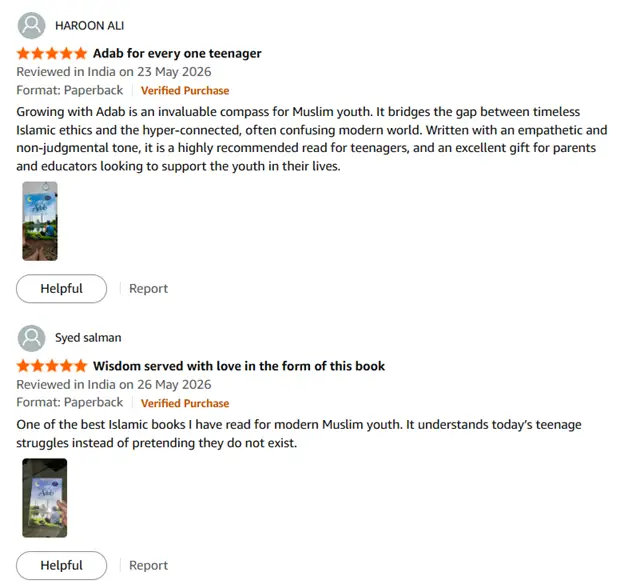
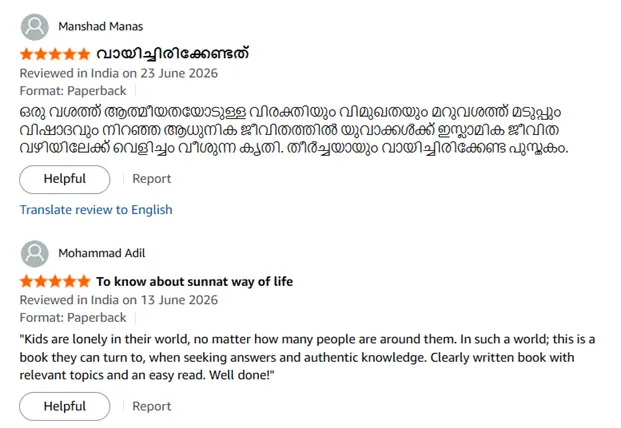
What Readers Are Saying About This Book