
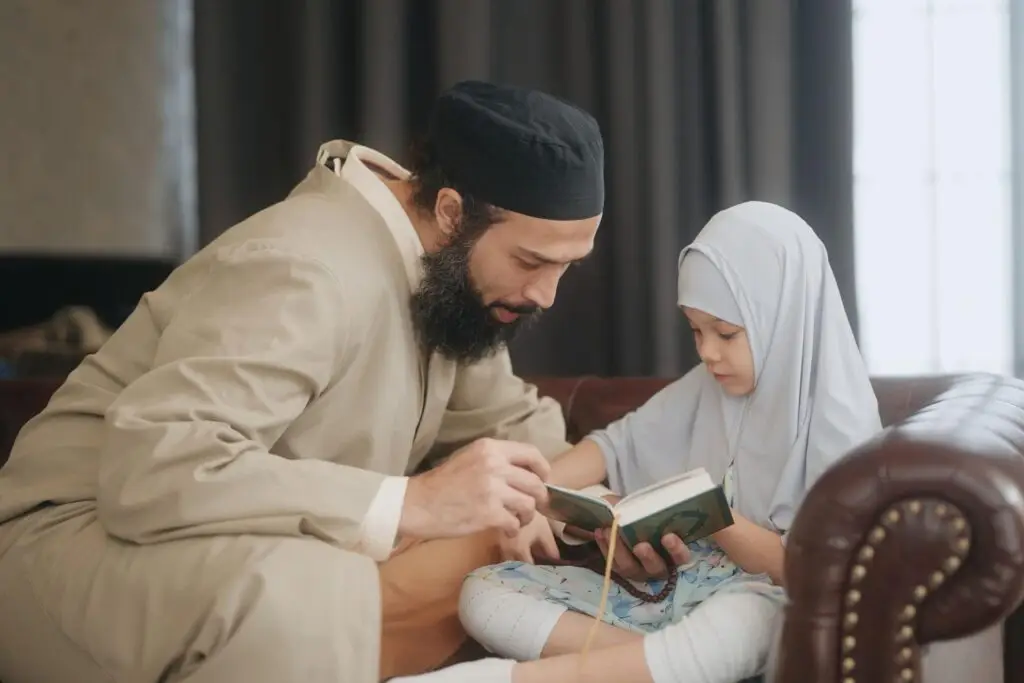
Teaching Deen to children is one of the most important duties a Muslim parent carries. It is not only about raising a child who can pray or recite. It is about nurturing a heart that loves Allah (SWT), understands why faith matters, and chooses what is right even when no one is watching.
Yet many loving, sincere parents make the same mistake: they unintentionally push their children away from Deen while trying to bring them closer.
This usually does not happen because of neglect. It happens because of habits that seem small at the time but shape how a child feels about Islam for years to come.
Here are five common mistakes parents make when teaching Deen to young children, and what to do instead.
1. Turning Deen into pressure instead of love
One of the biggest mistakes is introducing Deen through fear, force or constant correction.
A child keeps hearing: “Read properly.” “Do not do that, it is haram.” “You will be punished if you do not pray.”
Discipline has its place, but early childhood is not the stage for heavy pressure. Young children build emotional associations before they form deeper intellectual ones. If Deen feels like stress, they may begin to avoid it. If it feels like warmth, safety and love, they are far more likely to move towards it.
A better approach is to make Deen feel gentle and welcoming. Tell stories. Smile while teaching. Praise effort. Let your child feel that learning about Allah (SWT) is a source of comfort, not fear.
Also Read: Introducing Faith with Kindness: Know Your Prophets for Young Readers
2. Focusing only on rules, not meaning
Many parents are careful to teach children what to do, but spend less time explaining why it matters.
Children are told to pray, say Bismillah, tell the truth and behave well. But when actions are taught without meaning, they can become hollow. A child may obey outwardly while feeling no inward connection.
Children do not need long lectures. They need simple meaning in words they can understand. Tell them, “We pray because Allah (SWT) loves when we remember Him,” or, “We say Bismillah so Allah (SWT) puts barakah in what we do.”
When children understand even a little of the reason behind an action, they are more likely to carry it with sincerity.
3. Expecting adult-level discipline from young children
This mistake is common, and often subtle. Parents sometimes expect from children what even adults struggle to maintain: perfect salah, full concentration and immediate obedience.
But children are still learning. They will get distracted. They will forget. They will make mistakes. That is not failure. It is childhood.
When expectations are unrealistic, frustration builds on both sides. The parent feels disappointed, and the child feels inadequate.
A better approach is to think long-term. You are not trying to produce a perfect five-year-old. You are helping to shape a God-conscious adult over time. Patience is part of the process. So is repetition. So is mercy.
Also Read: The Path of the Caliphs – True Islamic Stories for Children (Ages 5–12)
4. Using Deen only in moments of correction
For many children, Deen appears only when they have done something wrong.
They hear, “Allah (SWT) does not like this,” or, “This is sinful,” or, “Stop doing that.”
Over time, this can create an unhealthy association in the child’s mind: Deen becomes linked only with restriction, guilt and disapproval.
That is a serious mistake. Children should experience Deen not only as a set of limits, but also as a source of beauty, gratitude and joy.
Bring Deen into happy moments too. Say, “Allah (SWT) loves kindness, and you were kind.” Say, “Look at the sky; Allah (SWT) made that for us.” Say, “Sharing is something Allah (SWT) loves.”
This teaches a child that Islam is not present only when they fail. It is also present in wonder, goodness and daily life.
5. Not modelling what you teach
Children learn far more from what parents do than from what parents say.
You may tell a child to pray, but if they rarely see you pray with calmness and attention, the lesson weakens. You may teach honesty, but if they notice contradiction, they become confused.
A child’s first experience of Deen is often not a book or a class. It is the example set at home.
That is why parents need to embody what they hope to pass on. Let your children see you pray. Let them hear you make dua. Let them notice your patience, your gratitude and your trust in Allah (SWT).
Your actions are their first madrasa.
Also check out: Relevant books
Final thought: you are planting seeds, not forcing growth
Teaching Deen is not about instant results. It is about planting seeds that may grow slowly, quietly and beautifully over time.
Some days, it will feel as though nothing is working. Some lessons will not seem to stay. Some reminders will need to be repeated many times.
That is normal.
What you are building is not just behaviour. You are helping to form belief, love and identity. And that takes time.
A simple rule may help. If your child feels safe with Deen, loved while learning, and curious about Allah (SWT), then you are moving in the right direction, even if progress seems small. Perfection is not the goal. A heart that wants to return to Allah (SWT) is.