

4 Rightly Guided Caliphs: Life Lessons Every Child Can Learn
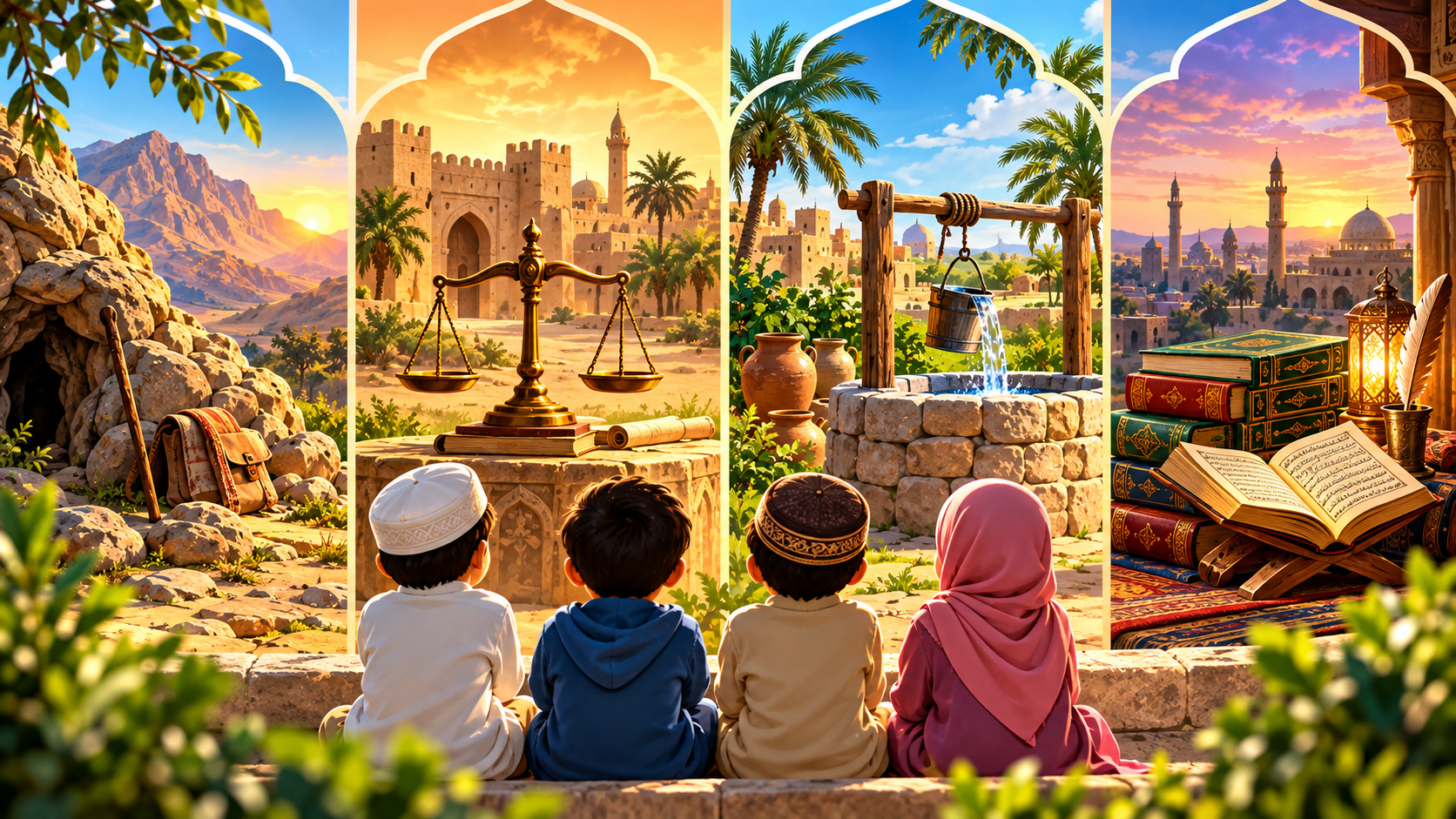
One was known for his kindness and loyalty. Another stood firmly for justice. The third showed extraordinary generosity and modesty, while the fourth combined courage with knowledge and wisdom. The four Rightly Guided Caliphs had different strengths, yet all four offer children valuable lessons about faith, character and leadership.
Every child is different.
Some are quiet and thoughtful. Others are confident, outspoken and eager to lead. Some enjoy helping people, while others are curious, constantly asking questions and searching for answers.
For parents, these differences can raise familiar questions. Should a shy child become more confident? Should an energetic child learn to be calmer? Should a sensitive child become tougher?
The lives of the four Rightly Guided Caliphs, known as the Khulafa-e-Rashideen, offer a valuable way to think about these questions.
Abu Bakr, Umar, Uthman and Ali (may Allah SWT be pleased with them all) each brought distinct strengths to their service of Islam. Their lives demonstrate that kindness, courage, generosity and wisdom can all contribute to good character and responsible leadership.
Also Read The Path of the Caliphs – True Islamic Stories for Children (Ages 5–12)
What can children learn from the four Rightly Guided Caliphs? Their stories teach that good character is not about having a particular personality. It is about developing faith, making thoughtful choices and using one's abilities to help others.
For parents looking for Islamic stories that teach children meaningful values, their lives provide a rich source of inspiration.
Abu Bakr (RA): The Quiet Strength of Kindness and Loyalty
Imagine hiding in a dark cave while people searching for you draw nearer. You can hear them approaching. If they look down, they might discover your hiding place.
This was the frightening situation faced by Prophet Muhammad (peace be upon him) and his close companion Abu Bakr As-Siddiq (RA) during their migration from Makkah to Madinah.
Abu Bakr (RA) feared for the Prophet's (PBUH) safety. When their pursuers came close to the cave, the Prophet (PBUH) reassured him, reminding him that Allah SWT was with them.
The Holy Qur'an refers to this moment in Surah At-Tawbah (9:40), while Sahih al-Bukhari (Hadith 3922) records Abu Bakr's (RA) concern and the Prophet's (PBUH)reassurance.
The incident reveals an important aspect of Abu Bakr's (RA) character: his deep loyalty and commitment to the Prophet (PBUH), even in moments of danger.
His courage was not limited to dramatic acts. It was also evident in his generosity, sincerity and willingness to help others.
Abu Bakr (RA) used his wealth to support the early Muslim community, including helping to free enslaved people who faced persecution.
His life reminds us that strength does not always announce itself through bold words or public recognition. Sometimes, it is found in quiet acts of kindness and unwavering support.
What can children learn from Abu Bakr (RA)?
A child does not need to be the loudest person in the classroom to make a difference.
Consider a quiet child who notices an unhappy classmate, shares lunch with someone who has forgotten theirs or stands beside a friend being treated unfairly.
These everyday actions may seem small, but they show kindness, loyalty and moral courage.
Abu Bakr's (RA) life offers four lessons for children:
- Kindness can be a form of courage.
- Loyalty means supporting others when life becomes difficult.
- True friendship requires trust, honesty and sincerity.
- Helping someone matters more than receiving praise for doing so.
For parents raising quiet or sensitive children, Abu Bakr's (RA) example offers a useful reminder: confidence does not always have to be loud.
Children can make a difference through compassion, reliability and thoughtful action.
A question for children: If your best friend was having a difficult day, what could you do to make them feel supported?
Abu Bakr's (RA) example shows the value of gentle strength. Umar ibn Al-Khattab's (RA) life offers a contrasting but equally important lesson: how determination and courage can serve justice.
Also Read Growing With Adab: A Powerful Book for Muslim Teen Identity, Faith and Family
Umar ibn Al-Khattab (RA): The Courage to Stand for What Is Right
Some children have strong personalities from an early age.
They question rules, express their opinions confidently and dislike seeing others treated unfairly. Their determination can be admirable, although it may sometimes lead to impatience or arguments.
With patience and guidance, however, these qualities can become strengths.
Umar ibn Al-Khattab (RA), the second Rightly Guided Caliph, is remembered for his courage, firmness and commitment to justice.
Before accepting Islam, Umar (RA) strongly opposed the new faith. After becoming Muslim, he directed his determination towards supporting Prophet Muhammad (peace be upon him) and the Muslim community.
His strength of character was widely recognised. Accounts in Sahih al-Bukhari describe his remarkable firmness, while historical accounts of his Caliphate highlight his concern for justice, public welfare and accountability.
For Umar (RA), leadership carried responsibility. Authority was not simply a means of exercising power; it brought duties towards the people under his care.
This offers children an important distinction.
Being strong does not mean being harsh. Being brave does not mean always getting one's own way.
True courage also involves recognising what is right and having the patience to act fairly.
What can children learn from Umar (RA)?
Imagine a school playground where several children refuse to let a younger pupil join their game.
One child notices the unfairness but remains silent. Another steps forward and politely asks the group to include everyone.
The second child demonstrates the kind of moral courage that Umar's (RA) life can inspire.
Umar's (RA) example teaches children that:
- Courage includes speaking up when someone is treated unfairly.
- Fairness means applying the same rules to everyone, including friends.
- Strong emotions should be guided by patience and self-control.
- Good leaders accept responsibility rather than blaming others.
These lessons are especially valuable for confident, energetic and outspoken children.
Instead of discouraging their determination, parents can help them combine it with empathy, patience and sound judgement.
A child who learns to speak firmly but kindly can become someone others trust.
A question for children: Would you speak up if someone was being treated unfairly, even if your friends disagreed with you?
Umar's (RA) life shows how courage and firmness can protect others. Yet leadership does not always require a forceful personality. Uthman ibn Affan (RA) demonstrated how gentleness and generosity could make a lasting difference.
Also check out: Relevant books
Uthman ibn Affan (RA): The Power of Gentleness and Generosity
In a world that often celebrates confidence and outward success, Uthman ibn Affan (RA) offers a different example of strength.
The third Rightly Guided Caliph was known for his modesty, generosity and gentle nature.
Uthman (RA) was a successful merchant with considerable wealth. Yet his generosity, rather than his possessions, became one of his most admired qualities.
One of the best-known examples concerns the Well of Rumah in Madinah.
At a time when access to good water was limited, Uthman (RA) purchased the well and made its water available to the community.
The incident is recorded in Jami at-Tirmidhi (Hadith 3703).
Consider what this meant to the people of Madinah.
Water was essential for drinking, cooking, washing and everyday life. By using his wealth to improve access to it, Uthman (RA) helped meet an important community need.
His generosity extended beyond this single act. He also contributed to the needs of the Muslim community during difficult periods.
During his Caliphate, Uthman (RA) oversaw another important undertaking: the preparation and distribution of standard written copies of the Holy Qur'an. This effort helped preserve consistency in the written text and promote unity within the growing Muslim community.
The account is recorded in Sahih al-Bukhari (Hadith 4987).
These contributions reveal two sides of Uthman's (RA) character.
He was gentle and modest, yet capable of taking responsibility for decisions that affected many people.
His life shows children that kindness and leadership are not opposites.
What can children learn from Uthman (RA)?
Children sometimes associate generosity with money, expensive presents or giving away possessions.
But generosity can take many forms.
A child can share school supplies, help a younger sibling, spend time with someone who feels lonely or donate books that are no longer needed.
What matters is the willingness to use something valuable to benefit another person.
Uthman's (RA) life teaches children that:
- Generosity is about sharing what we can, not how much we own.
- Modesty and confidence can exist together.
- Gentle people can make important decisions and lead responsibly.
- Helping others often requires patience, care and thoughtful planning.
Parents can encourage these qualities by involving children in simple acts of charity and service.
A child who learns to share time, attention and possessions begins to understand that generosity is a habit, not merely an occasional act.
A question for children: If you had something that could make life easier for many people, would you keep it for yourself or share it?
Uthman's (RA) example shows how generosity can benefit an entire community. Ali ibn Abi Talib (RA) offers another valuable lesson: the importance of bringing courage, knowledge and thoughtful judgement together.
Also Read How Muslim Students Can Balance Schoolwork, Salah and Playtime
Ali ibn Abi Talib (RA): The Strength of Knowledge, Courage and Wisdom
Ali ibn Abi Talib (RA), the fourth Rightly Guided Caliph, grew up in the household of Prophet Muhammad (peace be upon him).
He accepted Islam at a young age and became known for his courage, knowledge and close relationship with the Prophet (PBUH).
One notable incident occurred during the Battle of Khaybar.
According to Sahih al-Bukhari (Hadith 2975), the Prophet (PBUH) announced that the battle standard would be given to a man associated with love for Allah SWT and His Messenger (PBUH).
The standard was subsequently entrusted to Ali (RA).
The incident illustrates the important responsibility given to him and his courage in undertaking it.
Yet Ali's (RA) example extends beyond physical bravery.
He is also remembered for his knowledge, understanding of Islam and ability to exercise judgement.
His life offers children a valuable lesson: courage becomes more useful when accompanied by knowledge and wisdom.
A person may be brave enough to act, but wisdom helps them consider what they should do and how their actions may affect others.
What can children learn from Ali (RA)?
Many children have a natural desire to understand the world.
Why does something happen? Is there another way to solve a problem? How can we make a fair decision?
Such questions are signs of curiosity, and parents should encourage them.
Ali's (RA) example can inspire children to seek knowledge, think carefully and use what they learn responsibly.
His life offers four important lessons:
- Learning helps us make better decisions.
- Courage is most valuable when guided by wisdom.
- Young people can demonstrate faith, commitment and responsibility.
- Knowledge should be used to solve problems and benefit others.
For children who enjoy reading, asking questions or exploring new ideas, Ali's (RA) life provides an example of connecting knowledge with action.
Parents can develop this habit by encouraging children to explain their reasoning rather than simply giving an answer.
When a child faces a difficult situation, asking 'What do you think is the right thing to do, and why?' can encourage careful thought.
A question for children: When faced with a difficult choice, do you act immediately or take time to consider what is right?
Ali's life reminds us that knowledge, courage and responsibility work best together. When we consider his example alongside those of the other three Caliphs, a broader lesson emerges about character and leadership.
Four Different Strengths, One Shared Purpose
Abu Bakr, Umar, Uthman and Ali (may Allah SWT be pleased with them all) are remembered for many virtues. Their lives cannot be reduced to a single personality trait.
Yet their distinct strengths offer children accessible examples of good character.
|
Rightly Guided Caliph |
Strength highlighted |
Lesson for children |
|
Abu Bakr (RA) |
Kindness and loyalty |
Support others with sincerity and compassion |
|
Umar (RA) |
Courage and justice |
Stand up for what is right while treating others fairly |
|
Uthman (RA) |
Gentleness and generosity |
Share what you have and use it to help others |
|
Ali (RA) |
Knowledge and wisdom |
Think carefully, keep learning and act responsibly |
What connects these four examples is not personality but purpose.
Each Caliph sought to follow the teachings of Prophet Muhammad (peace be upon him) and serve the Muslim community.
Their lives remind us that good character is shaped not simply by our natural qualities, but by how we choose to use them.
A quiet child can become a compassionate leader.
A confident child can become a defender of fairness.
A generous child can learn to serve the community.
A curious child can develop the knowledge needed to guide others.
These qualities are not exclusive to particular personalities. Every child can learn kindness from Abu Bakr (RA), justice from Umar (RA), generosity from Uthman (RA) and wisdom from Ali (RA).
The aim is not to decide which Caliph a child most resembles. It is to help children develop a balanced character by learning from all four.
How Can Parents Teach Children These Islamic Values?
Learning about Islamic history becomes more meaningful when children can connect it with their own experiences.
Memorising names and events has value, but understanding the choices people made can help children apply those lessons in everyday life.
Parents can begin with simple conversations inspired by the lives of the Rightly Guided Caliphs.
1. Teach kindness through Abu Bakr's (RA) example
After reading about Abu Bakr's (RA) loyalty, ask your child to recall a time when a friend needed help.
Discuss how small acts of kindness can make someone feel supported.
You might encourage your child to check on a classmate who is upset or help someone without expecting praise.
2. Encourage fairness through Umar's (RA) example
Use Umar's (RA) commitment to justice to discuss situations your child recognises.
What should they do if someone is excluded from a game? How should they respond when a friend breaks a rule?
These conversations can help children understand that standing up for what is right requires both courage and fairness.
3. Practise generosity through Uthman's (RA) example
Uthman's (RA) generosity provides an opportunity for a practical family activity.
Children might choose books to donate, help prepare food for someone in need or contribute to a family charity project.
Encourage them to think about how their contribution could benefit another person.
4. Develop curiosity through Ali's example
Ali's knowledge and wisdom can inspire children to ask questions and consider different solutions.
When your child encounters a problem, invite them to think through the possible choices and consequences.
Rather than supplying the answer immediately, encourage them to explain their reasoning.
The purpose of these activities is not simply to teach children what the Caliphs did. It is to help them recognise opportunities to practise the same values.
Parents can also explain that every strength needs guidance.
A courageous child must learn patience. A generous child must develop responsibility. A thoughtful child must recognise when action is needed. A loyal child must understand that friendship should never come at the expense of truth and fairness.
Good character develops when children learn to balance their natural strengths with faith, discipline and consideration for others.
Learning About the Rightly Guided Caliphs Through Stories
For younger children, Islamic history can be easier to understand when presented through engaging stories.
A well-told story helps children imagine a situation, recognise the choices involved and think about how they might respond.
This approach is particularly useful when introducing the lives of the Khulafa-e-Rashideen.
Rather than beginning with long lists of historical facts, parents can introduce one meaningful incident at a time.
The story of Abu Bakr (RA) in the cave can encourage a discussion about friendship and trust. Umar's (RA) concern for justice can lead to conversations about fairness. Uthman's (RA) purchase of the Well of Rumah can inspire generosity, while Ali's courage and knowledge can encourage thoughtful decision-making.
Books can help bring these lessons together.
The Path of the Caliphs: True Stories of the Khulafa-e-Rashideen for Children Aged 5–12, compiled by the Fill Masjid App Team and edited by Abdul Wasey, introduces young readers to important episodes from the lives of all four Caliphs.
The illustrated book explores themes including Abu Bakr's (RA) loyalty and kindness, Umar's (RA) courage and fairness, Uthman's (RA) generosity and care for the Holy Qur'an, and Ali's bravery and faith.
For parents seeking Islamic stories for children aged 5–12, books of this kind can provide a starting point for family reading, discussion and character-building activities.
But reading should be the beginning rather than the end of the learning process.
After each story, parents can ask children what they admired, what they found difficult to understand and how they might practise a similar virtue.
When children connect historical examples with their own choices, the lessons become more meaningful.
Frequently Asked Questions About the Rightly Guided Caliphs
Who were the four Rightly Guided Caliphs?
The four Rightly Guided Caliphs were Abu Bakr As-Siddiq, Umar ibn Al-Khattab, Uthman ibn Affan and Ali ibn Abi Talib (may Allah SWT be pleased with them all). They led the Muslim community in succession after the death of Prophet Muhammad (peace be upon him) and are collectively known in Sunni Islamic tradition as the Khulafa-e-Rashideen.
What can children learn from the Rightly Guided Caliphs?
Children can learn about kindness, loyalty, courage, justice, generosity, knowledge and responsibility. The Caliphs' lives also teach that people with different strengths can serve the same purpose through faith and good character.
How can parents introduce the Khulafa-e-Rashideen to young children?
Parents can begin with short, age-appropriate stories, followed by simple questions and practical activities. Connecting the Caliphs' examples with familiar situations, such as sharing, helping friends and making fair decisions, can make Islamic history easier to understand.
Why is it important for children to learn about Islamic history?
Islamic history introduces children to examples of faith, perseverance, service and moral responsibility. When taught through thoughtful discussion, these stories can help children understand Islamic values and consider how to apply them in everyday life.
The Greatest Lesson: Every Child's Strengths Are a Responsibility
Every child has something valuable to offer.
Some show courage when others hesitate. Some notice when people need comfort. Others are generous with their time and possessions, while some enjoy learning and solving problems.
The lives of Abu Bakr, Umar, Uthman and Ali (may Allah SWT be pleased with them all) demonstrate that different strengths can contribute to the same noble purpose.
Their achievements were not shaped by personality alone. Faith, sacrifice, discipline and a commitment to doing what was right were central to their lives.
For parents, this offers an important reminder.
We do not need to make every child the same. Nor should we assume that a particular personality determines what a child can achieve.
Instead, we can help children recognise their strengths, understand their weaknesses and learn to use their abilities responsibly.
The goal is not simply to raise children who are confident, intelligent, courageous or kind. It is to raise children who use these qualities to please Allah SWT and do good for others.