

What Are the Best Islamic Books for Young Muslim Children?
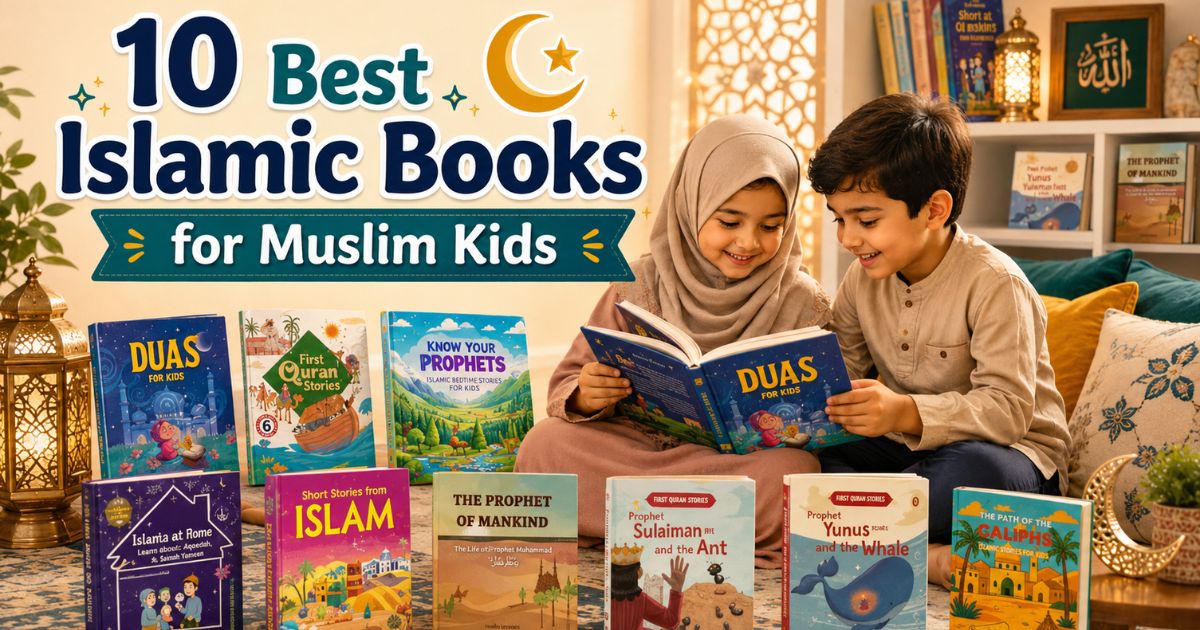
Finding Islamic books that children genuinely enjoy is not always easy.
Parents often want books that do more than keep children occupied. The best Islamic books for kids can help them learn about Allah (SWT), the Holy Quran, the Prophets, duas, good manners and Islamic history in a way that feels interesting rather than like another lesson.
Fortunately, there are now many colourful, thoughtful and age-appropriate Islamic books for young readers.
Whether you are building an Islamic home library, looking for a meaningful Eid gift or simply want your child to spend more time reading about Islam, here are 10 Islamic books for children worth considering.
Affiliate Disclosure: This article contains affiliate links. If you purchase through one of these links, we may earn a small commission at no additional cost to you.
1. Duas for Kids: Introduction to Arabic Duas with English Translations
One of the most valuable habits parents can help children develop is remembering Allah (SWT) throughout the day.
Duas for Kids introduces young readers to Arabic duas alongside English translations, helping children understand both what a dua means and when to say it.
That can make everyday duas feel more relevant. Children can learn supplications connected with waking up, eating, leaving home, travelling, going to sleep and thanking Allah (SWT).
Why parents may like it
- Introduces common everyday duas
- Helps children connect Arabic words with their meanings
- Encourages remembrance of Allah (SWT) during daily routines
- Works well for parent-child reading
- Supports regular Islamic learning at home
Best for: Children beginning to learn everyday duas.
2. First Quran Stories: 6-in-1 Illustrated Islamic Story Book for Kids
Children often understand Islamic lessons more easily through stories.
First Quran Stories brings together illustrated stories connected with the Prophets and Quranic teachings in a child-friendly format.
It can be especially useful for younger children who are beginning to discover the Holy Quran stories before they are ready for longer or more detailed books.
Parents can also use each story to begin simple conversations:
What happened? What did the Prophet do? What can we learn from this story?
Those discussions can be just as valuable as the reading itself.
Why parents may like it
- Introduces the Holy Quran stories in an accessible way
- Uses illustrations to keep younger children interested
- Encourages questions about the Prophets
- Gives parents opportunities to discuss faith and character
- Includes several stories in one collection
Best for: Young readers discovering the Holy Quran stories for the first time.
👉 Buy First Quran Stories on Amazon
3. Know Your Prophets: Islamic Bedtime Stories for Kids
Who was Prophet Nuh (AS)? What happened to Prophet Yusuf (AS)? What did Prophet Musa (AS) teach his people?
Children naturally ask questions about the Prophets.
Know Your Prophets introduces young readers to the 25 Prophets mentioned in the Holy Quran and presents their stories in a format designed for children.
Stories of the Prophets can help children understand qualities such as patience, courage, mercy, obedience, prayer and trust in Allah (SWT).
They also show children that the Prophets faced difficulties and responded to them with faith.
Why parents may like it
- Introduces children to the Prophets mentioned in the Holy Quran
- Makes Islamic history easier to understand
- Works well as bedtime reading
- Encourages conversations about faith and character
- Helps children remember important Islamic names and stories
Best for: Approximately ages 5–9 and family bedtime reading.
👉 Buy Know Your Prophets on Amazon
4. Islam at Home
Parents are often their children’s first teachers of Islam.
But knowing where to begin can feel difficult. Should you start with salah, the Holy Quran, Islamic manners, the Prophets or history?
Islam at Home brings several areas of Islamic learning together, including Aqeedah, Ibadah, Muslim character, the Holy Quran and Hadith, Islamic history, the Prophets and the Caliphs.
That makes it a useful option for families looking for something broader than a single storybook.
Instead of focusing on one topic, the book can provide a foundation for wider conversations about what Muslims believe and how those beliefs shape everyday life.
Why parents may like it
- Covers several areas of Islamic learning
- Supports a more structured learning routine at home
- Introduces both beliefs and practices
- Includes Islamic history alongside worship and character
- Gives parents topics to explore further
Best for: Families seeking a broad introduction to Islam at home.
5. Short Stories from Islam
Sometimes a five-minute story can teach a lesson more effectively than a long explanation.
Short Stories from Islam by Ziya Us Salam uses short narratives to introduce children to Islamic values and moral lessons.
Its short format makes it particularly practical for younger readers and busy families.
Try reading one story before bed, then ask:
“What do you think we can learn from it?”
That simple question can turn bedtime reading into meaningful Islamic learning.
Why parents may like it
- Short stories suit younger attention spans
- Makes Islamic values easier to discuss
- Useful for bedtime or quick family reading
- Encourages children to think about right and wrong
- Helps make Islamic reading a regular habit
Best for: Bedtime reading and children who prefer shorter stories.
👉 Buy Short Stories from Islam on Amazon
6. The Prophet of Mankind: Life of Prophet Muhammad ﷺ
Children hear the name of Prophet Muhammad ﷺ from a very young age.
But knowing his name is different from knowing his life and character.
The Prophet of Mankind introduces children to the Seerah, the life of Prophet Muhammad ﷺ, in a form intended for younger readers.
Learning Seerah can help children understand Islam through real events rather than through rules alone.
They can learn about the Prophet ﷺ as a son, husband, father, friend, leader and Messenger of Allah (SWT), as well as the kindness, patience, courage and mercy that shaped his life.
Why parents may like it
- Introduces children to the Seerah
- Helps develop love for Prophet Muhammad ﷺ
- Gives context to many Islamic teachings
- Encourages conversations about the Prophet’s character
- Helps children see Islamic values through real events
Best for: Children ready for a fuller introduction to the life of Prophet Muhammad ﷺ.
👉 Buy The Prophet of Mankind on Amazon
7. The Path of the Caliphs: Islamic Stories for Kids
What happened after the lifetime of Prophet Muhammad ﷺ?
For many children, their knowledge of early Islamic history ends there.
The Path of the Caliphs introduces children to the Khulafa-e-Rashideen, the Rightly Guided Caliphs, through stories about Abu Bakr (RA), Umar (RA), Uthman (RA) and Ali (RA).
Their lives can help children explore qualities such as courage, justice, generosity, leadership, friendship and responsibility.
The book can also help bridge the gap between learning the Seerah and discovering the early history of the Muslim community.
Why parents may like it
- Introduces the Rightly Guided Caliphs
- Expands Islamic learning beyond stories of the Prophets
- Teaches character through historical examples
- Encourages conversations about justice and leadership
- Written with younger readers in mind
Best for: Approximately ages 5–12 and children interested in Islamic history.
👉 Buy The Path of the Caliphs on Amazon
8. First Quran Stories: Prophet Yusuf’s (AS) Journey of Faith
The story of Prophet Yusuf (AS) contains lessons that children can return to as they grow older.
It is a story about family, jealousy, hardship, patience, temptation, forgiveness and trust in Allah (SWT).
An illustrated version can give younger children a gentle introduction before they explore the Quranic account in greater depth later.
Parents can use the story to discuss an important lesson:
Difficult things can happen even to good people, but a believer does not lose trust in Allah (SWT).
Why parents may like it
- Introduces one of the Holy Quran’s most memorable stories
- Teaches patience and trust in Allah (SWT)
- Opens discussions about jealousy and forgiveness
- Illustrated storytelling suits younger readers
- Can encourage children to explore the Quranic account later
Best for: Young children beginning to explore individual stories of the Prophets.
👉 Buy Prophet Yusuf’s Journey of Faith on Amazon
9. First Quran Stories: Prophet Sulaiman (AS) and the Ant
A tiny ant can teach a very big lesson.
The Quranic account of Prophet Sulaiman (AS) and the ant offers a simple way to teach children about kindness, humility, wisdom and respect for Allah (SWT)’s creation.
Prophet Sulaiman and the Ant is an illustrated board book designed for young readers, making it especially suitable for shared reading.
Its short format also makes it easy to include in a bedtime or family reading routine.
Why parents may like it
- Introduces a Quranic story in child-friendly language
- Encourages kindness towards animals and creation
- Teaches humility and wisdom
- Illustrations can engage reluctant readers
- Short enough for bedtime reading
Best for: Approximately ages 5–6 and younger children who enjoy picture books.
👉 Buy Prophet Sulaiman and the Ant on Amazon
10. First Quran Stories: Prophet Yunus (AS) and the Whale
Few Quranic stories capture a child’s imagination as quickly as the story of Prophet Yunus (AS) and the whale.
Behind the dramatic events is an even more important lesson: turn back to Allah (SWT), make dua and never lose hope in His mercy.
Prophet Yunus and the Whale is part of an illustrated the Holy Quran-story series for young readers.
Parents can use it to help children understand that making a mistake does not mean giving up.
We recognise what went wrong, turn to Allah (SWT) and try again.
Why parents may like it
- Introduces the story of Prophet Yunus (AS)
- Helps explain dua and repentance simply
- Reinforces hope in Allah (SWT)’s mercy
- Story and illustrations suit younger readers
- Works well as part of a wider the Holy Quran-story collection
Best for: Young children learning the Holy Quran stories through illustrated books.
👉 Buy Prophet Yunus and the Whale on Amazon
Which Islamic Book Is Best for Your Child?
There is no single Islamic book that is right for every child.
The best choice depends on your child’s age, reading ability and interests.
If your child is just beginning Islamic learning, start with a colourful Quran storybook or a simple dua book.
If they already know some stories of the Prophets, Know Your Prophets or a Seerah book may be the next step.
If they are becoming interested in Islamic history, The Path of the Caliphs can take their learning further.
For families wanting a more structured approach, a broader book such as Islam at Home may be useful.
More important than buying a large collection, however, is reading together.
Ten minutes before bed can become:
a Quran story,
a question,
a conversation,
and perhaps a lesson your child remembers for years.
Frequently Asked Questions
What are the best Islamic books for young Muslim children?
Good choices include books about the Holy Quran stories, the Prophets, Prophet Muhammad ﷺ, everyday duas, Islamic manners and early Islamic history. The best book depends on the child’s age, reading ability and interests.
What Islamic book should a child read first?
For younger children, an illustrated Quran storybook or a simple dua book is often a good starting point. Pictures, short text and familiar situations can make Islamic learning easier and more enjoyable.
What are good Islamic books for children aged 5–9?
Books about the Prophets, illustrated Quran stories, short Islamic moral stories and simple Seerah books can work well for children aged 5–9.
How can parents encourage children to read Islamic books?
Read with them instead of simply giving them a book. Set aside five or ten minutes regularly, let children choose the story and ask one or two simple questions afterwards.
Are Islamic storybooks useful for teaching children Islam?
Yes, they can be. Stories can make ideas such as patience, honesty, mercy and trust in Allah (SWT) easier for children to understand. They should complement, rather than replace, learning from the Holy Quran, authentic Islamic teaching and conversations with parents.
Are Islamic books good Eid gifts for children?
Yes. A carefully chosen Islamic book can make a meaningful Eid, Ramadan, birthday or everyday gift, particularly when it suits the child’s age and interests.
Build an Islamic Library Your Child Will Actually Read
A child’s Islamic library does not need hundreds of books.
Start with a few that your child genuinely enjoys.
Read them together.
Talk about them.
Return to favourite stories.
As children grow, gradually introduce more detailed books about the Holy Quran, Seerah, Hadith, Islamic history and character.
The goal is not simply to have Islamic books sitting beautifully on a shelf.
It is to help children want to open them.