

Brothers and Sisters in Islam: A Bond Allah Asks Us to Protect
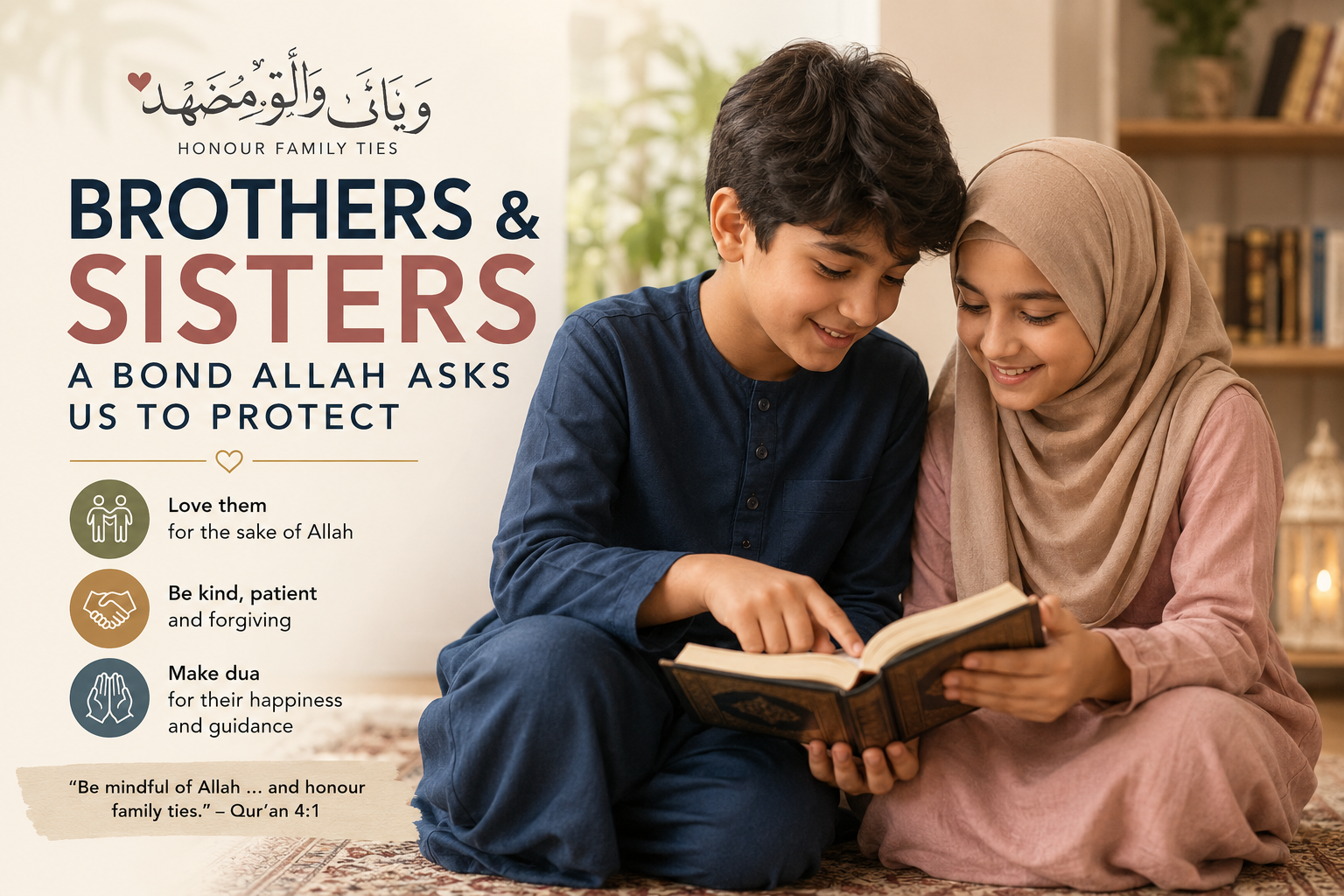
One minute you are laughing together.
Five minutes later, you are arguing over a charger, the television remote, clothes, food, or who told Mum what happened.
That is sibling life.
Brothers and sisters can irritate each other in a way almost nobody else can. They know your embarrassing stories. They remember what you were like as a child. They have seen you at your best and at your worst.
But beneath the teasing, arguments and everyday drama is something much deeper.
Your brother or sister is part of your rahim -- your family relationship and blood tie. In Islam, that bond is not meant to be treated casually. It is something Allah (SWT) asks us to honour and protect.
The Holy Qur’an tells believers to be mindful of Allah (SWT) and to honour family ties.
So a brother-sister relationship is more than living under one roof.
It can become an act of worship.
What’s Really Happening in a Sibling Relationship?
Sibling relationships are unusual because they change as we grow.
When you are young, your brother might be the person you play football with. Your sister might be the person sitting beside you during long family journeys.
Then life changes.
One sibling becomes busy with studies. Another starts working. Someone gets married. Someone moves away. Personalities become stronger. Old arguments sometimes remain in the background.
And something strange can happen.
We may speak more politely to classmates, colleagues and strangers than we speak to our own brothers and sisters.
We may forgive a friend quickly but remember something our sibling said three years ago.
We may reply to everyone online while ignoring a brother's message.
Islam asks us to notice this.
Good character is not only about how pleasant we appear outside the home. Family relationships are among the places where patience, mercy, forgiveness and sincerity become real.
The Prophet ﷺ taught the importance of being good to one's family and demonstrated that goodness in his own family life.
A healthy sibling bond does not mean brothers and sisters never disagree.
It means disagreements do not destroy the relationship.
Also Read Growing With Adab: A Powerful Book for Muslim Teen Identity, Faith and Family
The Islamic Perspective on Brothers and Sisters
1. Family Ties Are Sacred
Allah (SWT) says:
“Be mindful of Allah (SWT) -- in Whose Name you appeal to one another -- and honour family ties.”
-- The Holy Qur’an 4:1
This gives us the foundation.
Maintaining family relationships -- known as silat ar-rahim -- is part of Islamic character.
Your siblings are among your closest blood relatives. That means keeping a connection with them matters even after childhood ends.
A brother getting married does not mean he forgets his sister.
A sister moving to another city does not mean her brothers disappear from her life.
Growing older changes the form of the relationship, but it should not erase the relationship itself.
2. Kindness to Relatives Is a Qur’anic Instruction
Allah (SWT) commands Muslims to worship Him alone and, alongside other important social responsibilities, to show kindness to parents and relatives.
For brothers and sisters, kindness can appear in very ordinary ways.
It is checking whether your sibling reached home safely.
It is listening when they are worried.
It is sharing without constantly keeping score.
It is avoiding humiliating jokes.
It is helping when they are struggling.
It is making dua for them when they do not even know you are doing it.
Not every important Islamic action looks dramatic.
Sometimes maintaining family ties looks like sending a simple message:
“How are you?”
Check out: Relevant books
3. A Sibling Has Two Powerful Connections With You
When your brother or sister is Muslim, there are two relationships between you.
They are your relative.
And they are your fellow Muslim.
The Prophet ﷺ said that a Muslim is the brother of another Muslim: he does not wrong him or abandon him. He also taught that whoever helps with another Muslim's need will receive Allah's (SWT) help.
Think about how meaningful that becomes inside a family.
If Islam teaches us not to wrong another Muslim, our own siblings certainly should not become easy targets for cruelty.
A brother should not use his strength to frighten or control his sister.
A sister should not deliberately expose her brother's weaknesses to embarrass him.
Neither should use private family information as entertainment for friends or social media.
Being siblings gives us access to one another's vulnerable side.
Islam teaches us not to misuse that access.
4. Maintaining Ties Is Not Just “Being Nice When They Are Nice”
This may be one of the hardest parts of sibling relationships.
Sometimes you are trying.
They are not.
You send the message. They ignore it.
You apologise. They stay cold.
You try to make peace. They bring up another old argument.
The Prophet ﷺ taught that the person who truly maintains family ties is not simply the one who returns kindness with kindness. Rather, true maintenance of kinship includes reconnecting when the relationship has been cut.
That does not mean accepting abuse or pretending serious harm does not exist.
It means our goodness should not always depend on receiving identical treatment in return.
Sometimes maturity means saying:
“I cannot control their behaviour, but I can control mine.”
Also Read: The Path of the Caliphs – True Islamic Stories for Children (Ages 5–12)
5. Cutting Family Ties Is a Serious Matter
Islam does not treat deliberate estrangement between relatives as something insignificant.
The Prophet ﷺ gave a severe warning regarding the one who cuts the ties of kinship. This teaching is authentically reported in both Sahih al-Bukhari and Sahih Muslim.
That should make us careful about sentences such as:
“I will never speak to him again.”
“She is dead to me.”
“I don't care what happens to them.”
Anger can make permanent decisions feel reasonable for ten minutes.
But family relationships may last for decades.
Of course, some families contain genuine harm, abuse or serious danger. Maintaining kinship does not require a person to remain exposed to harm. Boundaries may sometimes be necessary. The important point is that normal arguments, jealousy and wounded pride should not casually become lifelong family separation.
What Rights Do Brothers and Sisters Have Over Each Other in Islam?
Islamic teachings on kinship create a strong moral framework for sibling relationships.
A brother or sister has the right to be treated with dignity.
They should not be mocked because of their appearance, grades, income, mistakes, marriage situation or personality.
They have a right not to be deliberately harmed or oppressed.
They deserve reasonable privacy.
They deserve sincere advice rather than public humiliation.
They deserve support during difficulty according to our ability.
They deserve to have family ties maintained rather than being forgotten because life becomes busy.
And when inheritance or other legally defined family rights arise, those rights must be respected according to Islamic law rather than manipulated through family pressure or cultural expectations.
The heart of all this is simple:
Being related gives us responsibilities, not permission to hurt one another.
Also Read: Introducing Faith with Kindness: Know Your Prophets for Young Readers
Brothers and Sisters Are Not Meant to Control Each Other
Sometimes culture can confuse family roles.
An older brother may start behaving as though every decision his younger siblings make requires his permission.
An older sister may expect younger siblings to obey her simply because she is older.
Respecting an elder sibling is beautiful Islamic manners.
But being older does not give someone unlimited authority.
A good brother advises rather than humiliates.
A good sister guides rather than controls.
A caring sibling protects without becoming possessive.
When correction is needed, the goal should be helping the person -- not proving power over them.
This matters especially as siblings enter their teenage and adult years.
A relationship built only on fear may survive inside one house.
A relationship built on respect can survive for life.
What Are the Duties of a Brother Towards His Sister?
A Muslim brother should want goodness for his sister.
Protection, however, should never become domination.
He should respect her dignity, defend her from injustice, avoid mocking or exposing her, support her during difficulty, and advise her with wisdom when advice is genuinely needed.
He should not make her feel that being protective means monitoring every movement, invading every private conversation or controlling every choice.
Real care makes another person feel safe.
It does not make them feel imprisoned.
A brother should also remember that his sister may one day live in another home, another city or another country. Marriage and adulthood do not cancel siblinghood.
She should still know:
“My brother cares about me.”
Also Read How Muslim Students Can Balance Schoolwork, Salah and Playtime
What Are the Duties of a Sister Towards Her Brother?
A Muslim sister should likewise want goodness for her brother.
She can support him when he is under pressure, advise him when he is making a mistake, respect his dignity and avoid using his weaknesses against him.
Brothers are not emotionless simply because they do not always talk about what they feel.
Sometimes a brother may be carrying academic pressure, financial worries, family expectations or personal struggles without saying much.
A thoughtful sister may notice what everyone else misses.
A few sincere words can matter:
“Are you okay?”
“I'm making dua for you.”
“You can talk to me.”
Sibling support does not always require solving the problem.
Sometimes being present is enough.
When Brothers and Sisters Fight
You will probably argue sometimes.
Islam does not expect families to become emotionless.
The question is what happens after the argument.
Do insults become personal?
Do you expose secrets?
Do you bring parents into every small disagreement?
Do you post indirect messages online?
Do you stop speaking for weeks because nobody wants to apologise first?
Or do you learn to repair things?
Saying “I was wrong” does not make you smaller.
Sometimes it is evidence that your ego has become smaller -- and your character has become bigger.
The Prophet ﷺ described the true maintainer of kinship as someone who continues the relationship even when relatives themselves have broken it.
That turns reconciliation into something greater than winning an argument.
It becomes worship.
Also Read The Right Age to Introduce Islamic History to Children (and How to Do It Well)
Practical Steps to Build a Stronger Brother-Sister Bond
You do not need a perfect relationship overnight. Start with small habits.
- Speak respectfully, especially when angry.
- Stop using embarrassing childhood stories as weapons.
- Knock before entering private spaces.
- Do not read messages, diaries or personal chats without permission.
- Avoid comparing siblings: “Why can't you be like him?” or “She is better than you.”
- Check on one another without waiting for a problem.
- Celebrate your sibling's success without jealousy.
- Give sincere advice privately rather than correcting them in front of everyone.
- Apologise when you cross a line.
- Forgive small mistakes instead of collecting them.
- Help with studies, work or family responsibilities when you can.
- Keep contact after moving away, marriage or major life changes.
- Do not allow spouses, friends or extended-family disagreements to create unnecessary hatred between siblings.
- Make dua for your brothers and sisters by name.
- If there is a long-standing argument, consider being the person who sends the first peaceful message.
Questions You Might Be Too Shy to Ask
Do I have to be best friends with my brother or sister?
No relationship can be forced into a particular personality.
Some siblings are extremely close. Others love and respect each other but have very different interests.
Islam asks for kindness, justice and maintaining kinship. You do not have to pretend you enjoy everything your sibling enjoys.
The goal is not identical personalities.
The goal is a healthy relationship.
What if my sibling is really annoying?
Then you have discovered one of the places where patience becomes practical.
You can set reasonable boundaries. You can ask for space. You can explain that something bothers you.
But irritation is not a licence to insult or humiliate someone.
Do I have to obey my older brother or sister?
Older siblings deserve respect, and their experience can make their advice valuable.
But simply being older does not give a sibling the same position or rights as a parent. Respect their good advice without turning siblinghood into a relationship of unnecessary control.
What if my brother or sister does not speak to me?
If it is safe and reasonable, keep the door of reconciliation open.
A greeting, message, Eid wish, kind gesture or sincere attempt to resolve the problem may be enough to show that you are not choosing to sever the relationship.
The Prophetic standard of maintaining kinship is especially meaningful when the other person is not making it easy.
What if the relationship is harmful?
Islam does not require someone to quietly accept abuse, violence or serious harm in the name of maintaining family ties.
Necessary boundaries can be different from revenge or hatred. In serious situations, involve trustworthy parents, responsible family members, qualified scholars or appropriate professional help.
Protecting yourself from harm and deliberately cutting family ties out of pride are not the same thing.
The Sibling You Have Today Will Not Always Be Across the Hall
Right now, your brother may be shouting from the next room.
Your sister may be borrowing something without asking.
You may argue about chores before dinner.
It can all feel ordinary.
But life moves.
One day, different jobs, homes, marriages, cities and responsibilities may separate the people who once ate at the same table every day.
That is why a sibling relationship should not be valued only after childhood is over.
Build it now.
There may come a day when the brother you found irritating becomes the person who stands beside you during one of the hardest moments of your life.
The sister you argued with over small things may become the person who remembers your childhood when almost nobody else does.
Family is one of Allah's (SWT) gifts.
And gifts require care.
Reflection: What Kind of Sibling Are You Becoming?
It is easy to ask:
“Is my brother good to me?”
“Does my sister respect me?”
A more powerful question is:
What kind of brother or sister am I?
Do people at home receive the same good manners that strangers receive from you?
Can your sibling trust you with something private?
Do they feel safe asking you for help?
Do you celebrate their happiness?
Can you apologise?
Can you forgive?
Can you make peace even when your ego wants to win?
Allah (SWT) commands us to honour family ties, and the Prophet ﷺ taught us that maintaining those ties becomes especially meaningful when relationships become difficult.
Your brother or sister does not need you to be perfect.
They need you to remember that the bond between you is worth protecting.
Sometimes that protection begins with something very small.
A message.
A smile.
An apology.
A dua.
Or simply being the first person to say:
“Are we okay?”
Frequently Asked Questions About Siblings in Islam
What does Islam say about brothers and sisters?
Islam places brothers and sisters within the important circle of family and kinship. The Qur’an commands believers to honour family ties and show kindness to relatives.
Is maintaining a relationship with siblings important in Islam?
Yes. Maintaining silat ar-rahim, or ties of kinship, is strongly emphasised in the Holy Qur’an and Sunnah. The Prophet ﷺ also warned against deliberately severing family relationships.
What are the main rights of siblings in Islam?
Sibling relationships should be based on kindness, justice, dignity, respect, protection from harm, sincere advice, reasonable privacy, assistance during difficulty and continued family connection. Specific legal rights, including inheritance, are governed by Islamic law.
Should siblings forgive each other?
Forgiveness and reconciliation are strongly encouraged. The Prophet ﷺ taught that genuine maintenance of family ties includes reaching out even when relatives have withdrawn from the relationship.
Does Islam allow boundaries with a harmful sibling?
Necessary boundaries may be appropriate when there is genuine harm. Maintaining kinship does not mean making yourself available for abuse. Where serious family problems exist, trustworthy religious and professional guidance should be sought.
Takeaway: In Islam, the bond between brothers and sisters is not built merely on shared parents or childhood memories. It is part of the sacred network of kinship Allah (SWT) commands us to honour. Love it, protect it, repair it when it breaks -- and do not wait until distance teaches you the value of the sibling who once lived just across the hall.