
Growing With Adab: A Muslim Teen Guide to Faith, Identity, Social Media and Real Life

Being a Muslim teenager today can sometimes feel like living in several worlds at once.
At home, faith may shape everyday life. At school, fitting in can feel important. Online, there is a constant stream of trends, opinions, comparisons and expectations.
How does a young Muslim bring all of this together without losing sight of who they are?
That is the question at the heart of Growing With Adab: A Muslim Teenager’s Guide to Faith, Hygiene, Character & Modern Life.
There are plenty of Islamic books for young children and many written for adults. But the teenage years sit somewhere in between -- and the questions often become far more complicated.
How do you stay close to Allah (SWT) when your iman feels weak? What do you do when friends pull you in the wrong direction? What if you feel uncomfortable being visibly Muslim? How should you deal with social media, appearance, hygiene, attraction, family disagreements, school pressure or doubts about faith?
Growing With Adab tries to talk about those questions in language teenagers can understand and relate to.
More importantly, it does not speak about Muslim teenagers as though they are a problem that needs fixing.
It speaks to them.
Muslim teenagers are growing up in a noisy world
The opening pages of Growing With Adab describe a young person surrounded by competing voices.
School pressure. Social media. Friendships. Comparison. Doubts. Family expectations. Emotional ups and downs. Questions about identity.
At the same time, many Muslim teenagers are trying to protect and strengthen their relationship with Allah (SWT).
That tension may sound familiar to many families.
A teenager may genuinely love Islam but struggle with salah. They may believe in Allah (SWT) while still having questions. They may want to dress or behave according to their faith but worry about looking different.
They may also love their parents while feeling that nobody at home fully understands what life outside the house is like.
Growing With Adab recognises that gap.
Its foreword describes the book as being for teenagers without ignoring their parents. In that sense, it tries to become a bridge between the two.
That may be one of its most useful qualities.
Want to look inside first?
Read sample pages of Growing With Adab on Google Play Books before buying the book.
“Why do I feel like a different person at school?”
One of the book's early chapters starts with a feeling many Muslim teenagers may recognise: being one person at home and someone slightly different everywhere else.
At home, there may be salah, the adhan and regular reminders about Islam.
At school, the jokes, conversations, expectations and ideas about what is “normal” may be very different.
Then there is social media, where everyone can appear confident, carefree and unrestricted.
A teenager may slowly begin editing parts of themselves.
Perhaps they stay quiet when Islam comes up. Perhaps they laugh at something they do not really agree with. Perhaps they hide aspects of their faith because they do not want to stand out.
Growing With Adab does not suggest that young Muslims should become argumentative or isolate themselves from everyone around them.
Its message is more practical: learn to become comfortable with who you are.
A teenager can be friendly without copying everything around them. They can be confident without becoming arrogant. And they can be visibly Muslim without turning every conversation into a debate.
It talks about subjects Muslim teenagers actually face
This is not simply a book about saying salaam politely and respecting elders.
Its scope is much wider.
The chapters include:
- Living Between Two Worlds
- Who Are You, Really?
- Your Relationship with Allah (SWT)
- When Faith Feels Weak
- Doubts, Questions and Confusion
- Your Body, Your Amanah
- Modesty in a Loud World
- Your Mind Matters Too
- Social Media and Your Soul
- Friends, Influence and Belonging
- Guarding Your Heart
- Speech, Manners and Character
- Parents, Family and the Generation Gap
- School, Ambition and Excellence
- Time, Habits and Self-Control
- Entertainment, Trends and Temptations
- Facing Islamophobia with Confidence
- Mistakes, Sin and Starting Again
- Living Islam in Public
- Questions You May Be Too Shy to Ask
- A Muslim Teen’s Daily Code
- Young Role Models in Islam
That range helps distinguish Growing With Adab from a conventional collection of Islamic reminders.
It tries to connect deen with the situations teenagers encounter in everyday life.
What if your iman feels weak?
One section deals with a question that some teenagers may find difficult to admit:
“I believe in Allah (SWT). So why do I sometimes feel far from Him?”
The book does not automatically treat low iman as rebellion or a lack of faith.
Instead, it looks at how tiredness, distraction, guilt, stress, endless scrolling, weak habits and constant noise can gradually affect a person's spiritual life.
Its approach is practical: start small.
One prayer on time.
One sincere dua.
Some istighfar.
A little less distraction.
One small act of worship that can be repeated consistently.
The message running through the book is simple: do not wait until you are perfect before trying to become better.
For a teenager already feeling guilty or overwhelmed, that distinction can matter.
Social media gets serious attention
Any conversation about teenagers, character and identity that ignores phones and social media is incomplete.
Growing With Adab does not ignore them.
It asks young readers to think about what they repeatedly watch, admire and compare themselves with.
Social media can make it appear that everyone else is more attractive, successful, popular or confident. Constant comparison can then begin to shape how a teenager sees their own worth.
The book also raises another important issue: religious knowledge online.
It warns young Muslims against allowing algorithms to become their religious teachers.
When teenagers have questions or doubts, the book encourages them to seek trustworthy knowledge rather than moving endlessly from videos to debates, reels and comment sections.
Its wider point is worth remembering: confidence online is not the same as truth.
That is an important lesson for young Muslims growing up with a phone rarely far from reach.
It talks openly about hygiene and awkward questions
Parents sometimes assume that teenagers already know certain things simply because they have never asked about them.
Teenagers, meanwhile, may be too embarrassed to ask.
Growing With Adab includes a section on the body as an amanah -- a trust from Allah (SWT).
It discusses cleanliness, grooming, clean clothes and personal hygiene in straightforward language without treating the normal changes of puberty as something shameful.
That matters.
A teenager should not have to learn every sensitive subject from friends, random websites or social media because the adults around them felt too awkward to explain it.
Later, the book includes an entire chapter called “Questions You May Be Too Shy to Ask.”
The principle behind it is simple: it is better to ask a necessary question respectfully than to remain confused.
Parents may want to read it too
Although Growing With Adab is written mainly for Muslim teenagers, some of its most useful sections may also be valuable for parents.
Consider a familiar family situation.
A teenager wants to feel understood.
The parents want them to behave responsibly.
The teenager wants more space.
The parents worry that they are losing control.
Then an argument about a phone, clothes, friends, studies, privacy or religious practice turns into something much bigger.
The book does not pretend that every disagreement between parents and teenagers has an easy answer.
Instead, it repeatedly returns to dignity, patience, timing and thoughtful communication.
That makes Growing With Adab useful not just as a book to hand to a teenager, but as a possible starting point for family conversations.
Parents could read it as well.
A mother or father may begin to see what certain teenage struggles look like from the other side. A teenager, in turn, may better understand why parental concern can sometimes sound stricter than intended.
The foreword sums up the parent's role through three ideas: guidance with mercy, truth with wisdom, and love without humiliation.
Those ideas can shape far more than one conversation.
What about school, grades and ambition?
The book also avoids treating religious development as something separate from education, ambition and everyday responsibilities.
It encourages Muslim teenagers to take school seriously without allowing grades to determine their worth.
The balance is straightforward:
Study properly.
Plan realistically.
Compare yourself less with others.
Respect your teachers.
Work consistently.
But do not allow somebody else's marks to destroy your confidence or sense of worth.
For families raising children in highly competitive academic environments, that balance may be particularly worth discussing.
How should Muslim teenagers deal with Islamophobia?
Another chapter looks at Islamophobia and the experience of being visibly Muslim.
A teenager may hear comments about their name, hijab, beard, prayer or religion. Sometimes the remark is presented as a joke. At other times, the hostility may be more direct.
Growing With Adab discusses how young Muslims can respond without becoming ashamed of their identity -- and without feeling that they must debate everyone they meet.
The emphasis is on building confidence through knowledge.
Know when something is worth explaining.
Know when it is better to walk away.
And remember that another person's stereotype does not determine your worth.
For young Muslims learning how to live their faith confidently in public, that is a useful distinction.
What happens when a teenager makes a mistake?
Advice aimed at Muslim teenagers can sometimes spend so much time warning them about mistakes that it forgets to explain what happens after a mistake has already been made.
Growing With Adab deliberately talks about repentance, recovery and starting again.
Its message is not that mistakes do not matter.
They do.
But one poor decision does not have to become a teenager's entire identity.
The book encourages young readers to recognise triggers, change harmful habits, make tawbah and begin again rather than allowing shame to push them further from Allah (SWT).
A teenager does not have to become flawless overnight.
They do need to learn how to return, repair and grow.
Adab means more than “good manners”
The word adab is sometimes translated simply as “manners”.
In Growing With Adab, its meaning is much wider.
Adab can be seen in:
- how you speak;
- how you behave when nobody is watching;
- how you treat your parents;
- how you use social media;
- how seriously you approach your studies;
- how you respond to someone who dislikes your faith;
- how you care for your body;
- how you admit a mistake; and
- how you treat someone who can offer you nothing in return.
Ultimately, it is about how closely everyday behaviour reflects the values a person says they believe in.
That is why the book does not end by promising one dramatic transformation.
Its idea is much simpler: a strong Muslim life is often built through ordinary good habits repeated consistently.
Who should read Growing With Adab?
The book may be particularly useful for:
- Muslim teenagers aged 13–19 looking for Islamic guidance that relates to the world they actually live in;
- parents of Muslim teenagers who want to understand pressures their children may not discuss openly;
- Islamic schools and teachers looking for material on faith, identity, character and modern teenage life;
- young Muslims struggling with confidence or belonging and wondering how Islam fits into school, friendships and online life; and
- families looking for an Islamic gift for a teenager that goes beyond simple stories and opens the door to more mature conversations.
Where to buy Growing With Adab
Growing With Adab is available in print and digital formats through several platforms.
Amazon India
Buy Growing With Adab on Amazon India
Kindle
Read Growing With Adab on Kindle
Meesho
Buy Growing With Adab on Meesho
JioMart
Buy Growing With Adab on JioMart
Google Play Books
Buy Growing With Adab on Google Play Books
Read Growing With Adab before you buy
Not sure whether the book is right for you or your teenager?
Read sample pages of Growing With Adab free on Google Play Books
Reading a few pages first can help parents and teenagers get a sense of the book's language, approach and subjects before deciding whether it is right for them.
A book to read -- and talk about
Perhaps the best way to use Growing With Adab is not to hand it to a teenager and then forget about it.
Read a chapter.
Talk about it.
Disagree with something.
Ask another question.
Discuss what school really feels like.
Talk about why salah sometimes feels difficult.
Ask what social media is doing to confidence and self-image.
Talk about friendships.
Talk about mistakes without turning the conversation into humiliation.
And ask a bigger question: what kind of Muslim does the teenager want to become?
That is ultimately what Growing With Adab tries to encourage.
Not simply a teenager who looks religious from the outside, but a young Muslim who begins to understand their faith, knows why it matters and learns how to carry it into everyday life.
For many families, that may be the conversation worth starting.
Preview Growing With Adab on Google Play Books →
Frequently Asked Questions
What is Growing With Adab about?
Growing With Adab is an Islamic guide for Muslim teenagers covering faith, identity, character, hygiene, social media, friendships, family life, school, doubts and everyday challenges.
Who is Growing With Adab for?
The book is mainly aimed at Muslim teenagers aged 13–19, but parents, teachers and Islamic educators may also find it useful.
Does Growing With Adab discuss social media?
Yes. The book looks at social-media habits, comparison, online influence, self-worth and the importance of seeking trustworthy religious knowledge.
Can parents read Growing With Adab too?
Yes. Several chapters deal with family relationships, communication and the generation gap, making the book useful for parents as well as teenagers.
Where can I buy Growing With Adab?
The book is available through platforms including Amazon India, Kindle, Meesho, JioMart and Google Play Books.
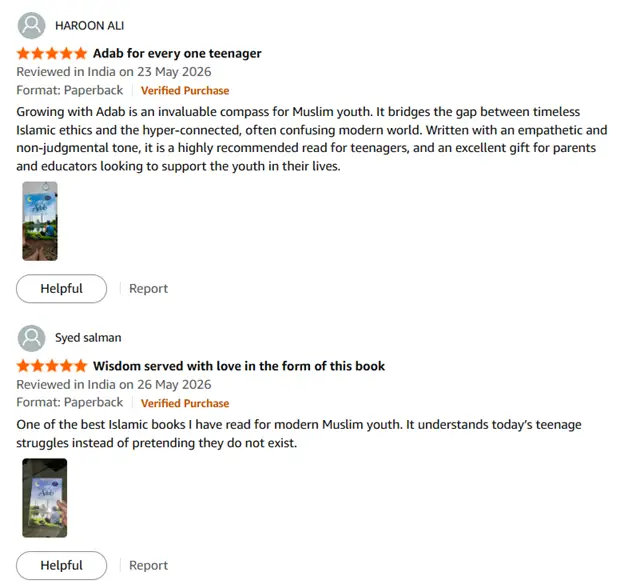
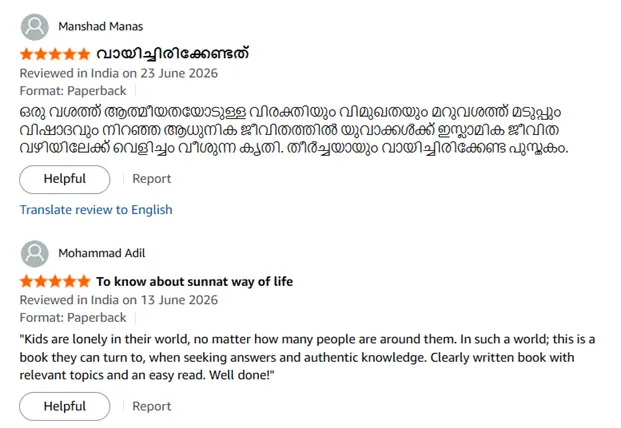
What Readers Are Saying About This Book