

How to Disagree Without Being Rude: Islamic Manners for Students
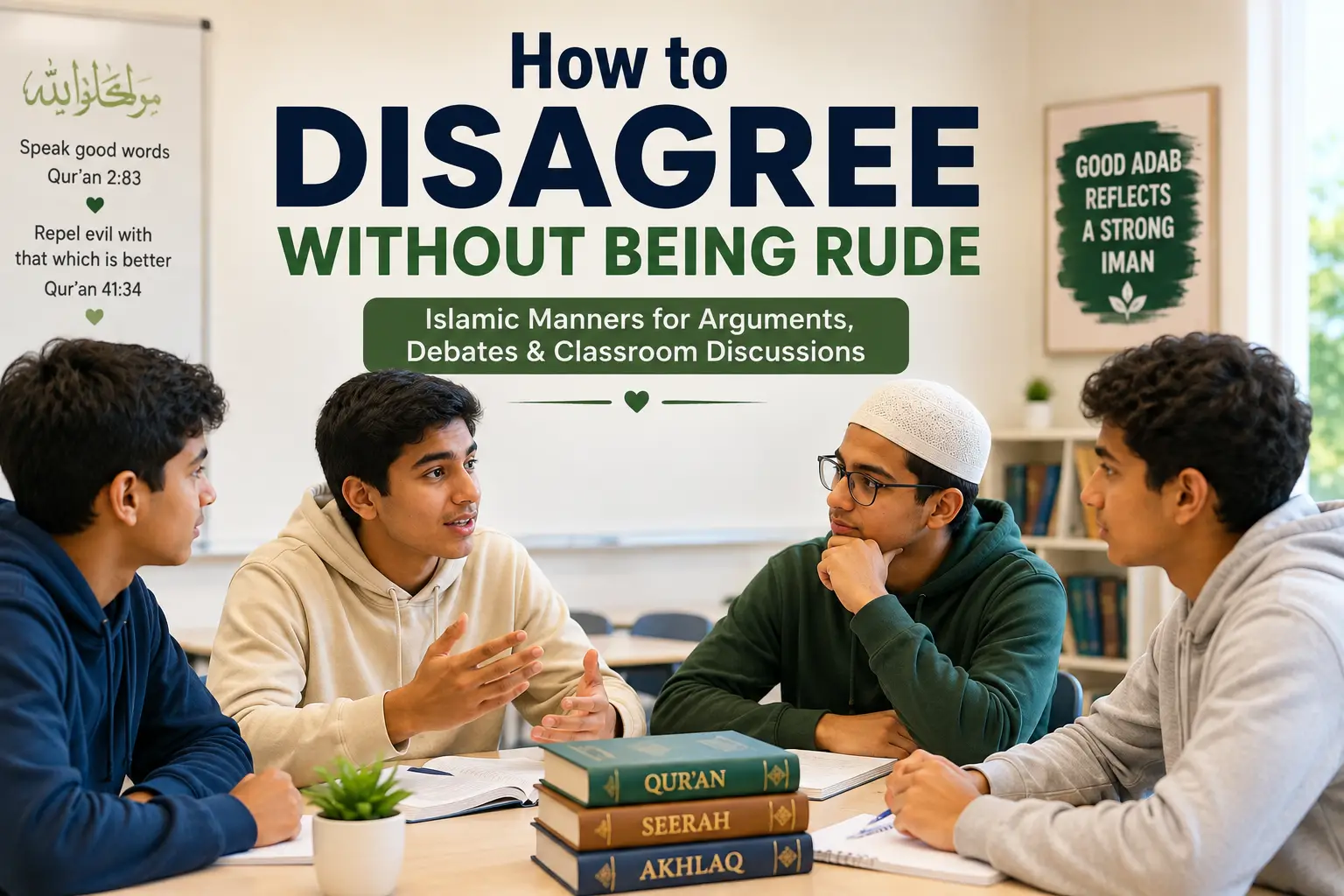
You are sitting in class when someone says something you strongly disagree with.
Maybe it is about religion, politics, school rules, social media or something happening in the world.
You raise your hand.
Then someone interrupts you.
You interrupt them back.
Their voice gets louder. Yours does too.
A discussion that began with ideas suddenly becomes personal.
“Bro, that makes no sense.”
“You clearly don’t know what you’re talking about.”
Now nobody is really listening.
We often think good communication means knowing how to prove our point. But sometimes the real test is knowing how to disagree without being rude.
For a Muslim, being right is not enough. Good manners, or adab, matter too.
Also Read Growing With Adab: A Powerful Book for Muslim Teen Identity, Faith and Family
Is It Wrong to Disagree in Islam?
No.
Islam does not teach Muslims to avoid every disagreement. People can look at the same issue and reach different conclusions.
Your classmates will not always agree with you. Your friends may have different opinions. Even people in the same family may see things differently.
The problem is not disagreement itself.
The problem begins when ego takes control.
Instead of thinking, “I want to understand this properly,” we start thinking, “I need to win.”
Then we stop listening. We interrupt. We become sarcastic. We attack the person instead of discussing the idea.
Sometimes we even enjoy embarrassing someone because others are watching.
Social media can make this worse. Online arguments often reward the sharpest insult or the most humiliating reply.
A Muslim should ask two questions:
“Was I right?”
And just as importantly:
“Was I respectful?”
Check out: Relevant books
What Does Islam Teach About Speaking During Disagreements?
Islam places great importance on good speech.
Allah (SWT) says:
“And speak to people good words.”
The Holy Qur’an 2:83
Good speech is not only for people who agree with us.
Our manners are tested most when someone challenges us, annoys us or says something we strongly dislike.
Allah also says:
“Repel evil with that which is better.”
The Holy Qur’an 41:34
That requires self-control.
Anyone can remain polite when everything is going their way. Staying calm when you feel angry or misunderstood takes greater strength.
The Prophet Muhammad ﷺ also warned against needless arguing and praised the person who gives up an argument even when they are right.
This does not mean you should never explain your opinion.
It means you should not turn every disagreement into a battle.
Sometimes you can make your point clearly and respectfully, and then leave the matter there.
Why Gentle Speech Matters
The Holy Qur’an gives a striking example when Allah (SWT) instructed Musa and Harun عليهما السلام to speak gently to Pharaoh:
“And speak to him with gentle speech.”
The Holy Qur’an 20:44
Think about that.
If gentle speech mattered in such a serious situation, it certainly matters during a classroom discussion, a football debate or an argument with a friend.
Being respectful does not make your argument weaker.
Often, it makes people more willing to listen.
Also Read: The Path of the Caliphs – True Islamic Stories for Children (Ages 5–12)
How Can You Disagree Respectfully?
When a disagreement begins, try these simple habits:
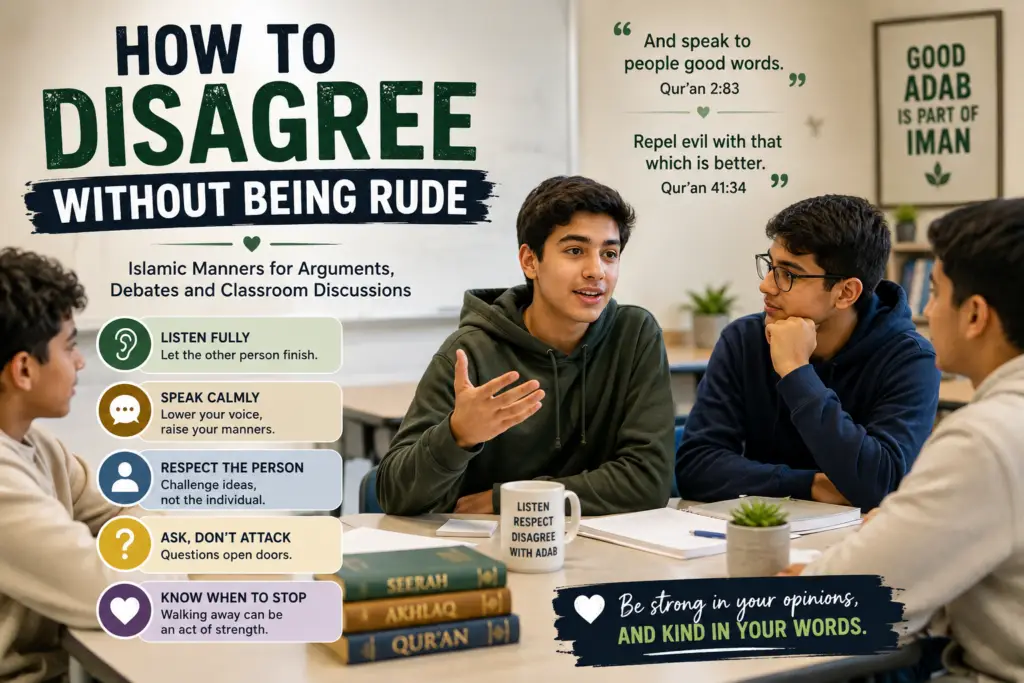
- Listen until the other person finishes. Do not spend the whole time planning your comeback.
- Keep your voice calm. Speaking louder does not make you more correct.
- Challenge the idea, not the person. Say, “I see it differently,” rather than, “You’re stupid.”
- Ask questions. “What makes you think that?” can lead to a better conversation.
- Avoid sarcasm and mockery. Making people laugh at someone is not the same as proving them wrong.
- Admit when someone makes a good point. Saying, “That part makes sense,” shows confidence, not weakness.
- Say “I don’t know” when you do not know. Truth matters more than pretending to have every answer.
- Check your intention. Are you trying to understand the truth, or simply trying to look smarter?
- Know when to stop. If the discussion becomes angry, repetitive or disrespectful, stepping away may be the wiser choice.
- Apologise if you cross the line. A simple “Sorry, I became too aggressive” can repair a lot.
Useful Phrases for Classroom Discussions
You do not need complicated words to disagree politely.
Try saying:
- “I understand your point, but I see it differently.”
- “I might be wrong, but this is how I understood it.”
- “Can you explain why you think that?”
- “I agree with part of what you said, but not all of it.”
- “I see what you mean, but I have a different view.”
- “Let’s disagree without making it personal.”
These phrases sound simple, but they show maturity and self-control.
Also Read How Muslim Students Can Balance Schoolwork, Salah and Playtime
What If the Other Person Is Obviously Wrong?
You can still correct them respectfully.
Being correct does not give you permission to humiliate someone.
Explain your point calmly. Give evidence if you have it. Then allow the other person to respond.
Your goal should be to clarify the truth, not embarrass someone.
What If Someone Insults Islam?
You do not have to pretend that disrespect is acceptable.
You can respond firmly without becoming abusive or aggressive. If it happens at school, you may need to tell a teacher or another responsible adult rather than allowing the situation to become heated.
Standing up for your beliefs and maintaining good manners can happen at the same time.
What If People Think I Lost Because I Stopped Arguing?
Stopping does not always mean losing.
Sometimes it means you had enough self-control to recognise that the discussion was going nowhere.
There is no prize for having the last word.
Walking away from a pointless argument may show more strength than continuing it.
Can You Joke During a Debate?
Yes, if the humour is kind.
A joke becomes a problem when its purpose is to embarrass, insult or mock the other person.
If everyone is laughing at someone rather than discussing the issue, the conversation has probably stopped being healthy.
Also Read: Introducing Faith with Kindness: Know Your Prophets for Young Readers
How Should Muslims Disagree on Social Media?
Online discussions need the same manners as face-to-face conversations.
Before replying, ask yourself:
- Am I responding to the idea or attacking the person?
- Would I say these words if we were sitting together?
- Am I sharing something I know is true?
- Will my comment improve the discussion?
- Am I replying because it is useful, or because I am angry?
Sometimes the best online reply is no reply at all.
You do not have to join every argument you see.
Good Adab Is More Important Than Winning
Before your next disagreement, remember something important:
The person in front of you is not your enemy simply because they have a different opinion.
You can disagree strongly and still be respectful.
You can correct someone without humiliating them.
You can defend your beliefs without becoming rude.
Sometimes the strongest sentence in an argument is:
“I understand what you’re saying. I still disagree, but I respect you.”
Good adab does not mean having no opinions.
It means carrying your opinions with humility, patience and self-control.
Because for a Muslim, winning an argument is never more important than protecting your character.
Also Read What Does Islam Teach About Loving Your Country?
Frequently Asked Questions
Is arguing forbidden in Islam?
Not every disagreement is forbidden. Islam allows discussion and debate, but Muslims are encouraged to avoid pointless arguments, insults and behaviour driven by ego.
How should a Muslim disagree with someone?
Listen carefully, speak calmly, avoid insults, focus on the issue rather than the person and stop when the discussion becomes unhelpful.
What does Islam say about rude speech?
The Holy Qur’an repeatedly encourages good, gentle and just speech. Muslims should avoid mockery, humiliation and unnecessary harshness.
Is it better to walk away from an argument?
Sometimes, yes. If a discussion becomes angry, repetitive or disrespectful, ending it may be wiser than trying to have the last word.
How can students disagree politely in class?
Students can use phrases such as “I understand your point, but I see it differently” or “Can you explain why you think that?” These keep the discussion respectful and focused.