

When Your Child Says, “That’s Not Fair!” — Lessons from the Prophets About Patience
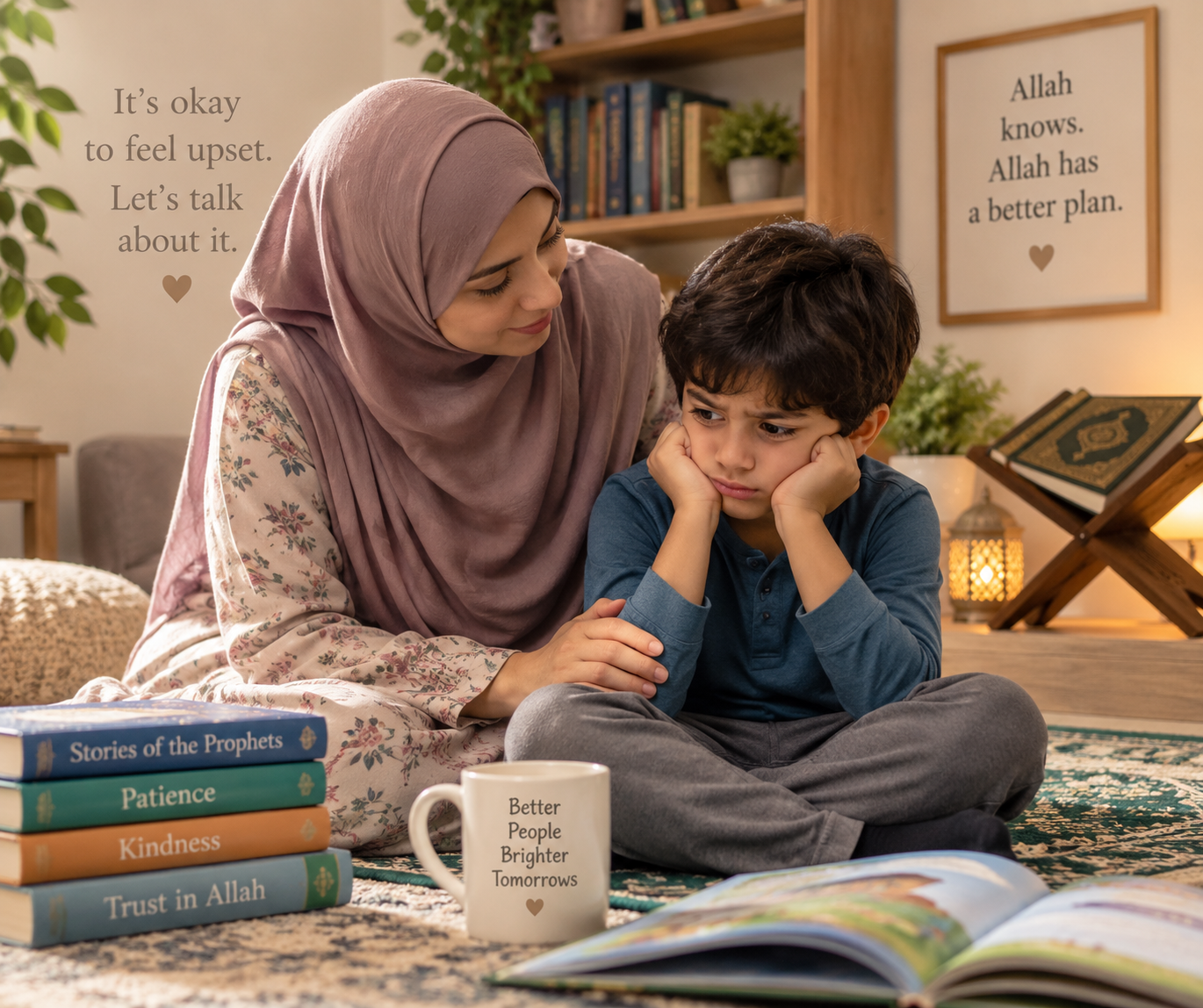
“Why does he get to stay up later?”
“You always take her side!”
“That’s not fair!”
Most parents have heard these words more times than they can count.
Sometimes the complaint comes over something small: who got the bigger slice of cake, who gets the front seat, or whose turn it is to choose the movie.
Other times, the feeling is much deeper. A child may be struggling because a friend was chosen instead of them, a sibling seems to receive more attention, or they worked hard for something and still did not get the result they hoped for.
As adults, we may be tempted to respond quickly.
“Life isn’t always fair.”
“Stop complaining.”
“You need to be grateful.”
The words may be technically true. But in that moment, our child may need more than a correction.
They need help learning what to do when life does not go the way they expected.
And this is where the stories of the Prophets become incredibly powerful.
What’s Really Happening When a Child Says, “That’s Not Fair”?
When children talk about fairness, they are often trying to make sense of disappointment.
They are asking questions such as:
“Why did this happen to me?”
“Why did someone else get what I wanted?”
“Does anyone understand how I feel?”
These are not necessarily signs of bad character. They are opportunities to teach character.
Patience in Islam does not mean pretending that something does not hurt. Nor does it mean never feeling upset.
Patience means learning how to respond to difficulty without allowing frustration to control our words, choices, and relationship with Allah (SWT).
That is a skill children develop slowly.
And they learn it best when patience is shown to them through real stories rather than simply demanded from them.
Also Read Introducing Faith with Kindness: Know Your Prophets for Young Readers
Prophet Yusuf (AS): When Life Feels Deeply Unfair
Few stories show this more clearly than the story of Prophet Yusuf عليه السلام.
As a young boy, Yusuf was harmed by his own brothers. He was separated from his father, thrown into a well, taken far from home, falsely accused, and later imprisoned despite being innocent.
From a human point of view, there were many moments when he could have said:
“This is not fair.”
Yet the Holy Qur’an does not show Yusuf becoming bitter or cruel.
He continued to trust Allah (SWT).
Years later, when he was finally reunited with his brothers and had the power to punish them, he chose forgiveness.
He told them:
“No blame will there be upon you today.”
(The Holy Qur’an 12:92)
This does not mean that what happened to Yusuf was acceptable.
It means that injustice did not decide the kind of person he became.
That is a powerful lesson for a child.
We can tell them:
“You may not be able to control what someone else does. But you can choose what happens inside your own heart.”
Prophet Ya‘qub (AS): Patience Can Include Tears
Parents can also learn something important from Yusuf’s father, Prophet Ya‘qub عليه السلام.
When Yusuf disappeared, Ya‘qub experienced enormous sadness.
He did not pretend that everything was fine.
He cried. He missed his son. He carried that sadness for years.
Yet he said:
“So patience is most fitting.”
(The Holy Qur’an 12:18)
Later, he explained that he took his sadness to Allah (SWT):
“I only complain of my suffering and my grief to Allah (SWT).”
(The Holy Qur’an 12:86)
This is an important message for children who think patience means they are not allowed to feel disappointed.
A child can be patient and still feel sad.
They can be patient and still cry.
They can be patient and still tell you that something hurt.
Our job is not always to remove the emotion immediately.
Sometimes our job is to teach them where to take that emotion.
Also Read The Path of the Caliphs – True Islamic Stories for Children (Ages 5–12)
Prophet Ayyub (AS): Patience During Long Difficulties
Some problems disappear quickly.
Others do not.
Prophet Ayyub عليه السلام experienced prolonged hardship. Yet when he called upon Allah (SWT), he spoke with humility:
“Indeed, adversity has touched me, and You are the Most Merciful of the merciful.”
(The Holy Qur’an 21:83)
Notice the balance.
He acknowledged his difficulty, but he did not lose hope in Allah (SWT).
Children need this balance too.
When something difficult happens, we do not have to rush into saying:
“Don’t worry. Everything will be fine.”
Sometimes we do not know when things will become easier.
Instead, we can teach them:
“This is difficult. Allah (SWT) knows it is difficult. And we can keep trusting Him while we work through it.”
That is a much deeper form of patience.
Prophet Muhammad ﷺ: Strength Without Bitterness
The life of Prophet Muhammad ﷺ is also filled with moments that appeared deeply unfair.
He was mocked, rejected, insulted, harmed, and driven from his home.
At Ta’if, he was treated with extraordinary cruelty.
Yet hardship did not make him harsh-hearted.
When he later had strength and authority, mercy remained part of his character.
This is one of the most important lessons we can give our children.
Real strength is not getting revenge every time someone hurts us.
Sometimes strength means remaining principled when we have every opportunity to become bitter.
The Prophet ﷺ taught:
“The strong person is not the one who overcomes others by strength, but the strong person is the one who controls himself while in anger.”
(Sahih al-Bukhari and Sahih Muslim)
For a child, that might mean walking away from an argument.
For a teenager, it might mean refusing to send an angry message.
For a sibling, it might mean choosing not to insult back.
These ordinary moments are where patience begins to grow.
Also Read Growing With Adab: A Powerful Book for Muslim Teen Identity, Faith and Family
What Parents Can Do in the Moment
The next time your child says, “That’s not fair,” you do not need to give them a long lecture.
Try something simpler:
- Acknowledge the feeling first. Say, “I can see why that feels unfair to you.”
- Ask what is hurting. Sometimes the real issue is not the toy, privilege, or decision. Your child may be feeling overlooked or embarrassed.
- Separate feelings from behaviour. It is okay to feel disappointed. It is not okay to scream, insult, or hurt someone.
- Connect the moment to a Prophetic story. Ask, “Do you remember what Prophet Yusuf (AS) did when people treated him unfairly?”
- Teach a short response. Encourage your child to say, “Allah (SWT) knows what happened. I will try to respond in a good way.”
- Let them see your patience too. Children notice how we respond to traffic, delays, difficult relatives, mistakes, and disappointments.
- Praise the effort, not only the outcome. Say, “You were upset, but you still spoke respectfully. That was real patience.”
These conversations do not have to feel like formal Islamic lessons.
Often, a two-minute conversation at the right moment stays in a child’s heart longer than a twenty-minute lecture.
Stories Give Children a Language for Character
One reason the stories of the Prophets are so valuable is that they turn abstract qualities into something children can picture.
“Be patient” can feel vague.
But Prophet Yusuf (AS) waiting through years of difficulty makes patience real.
“Trust Allah (SWT)” can sound like an instruction.
But Prophet Ya‘qub (AS) turning his grief toward Allah (SWT) shows what that trust looks like.
“Control your anger” can sound difficult.
But learning how the Prophet Muhammad ﷺ responded to hostility gives children an example to remember.
This is why regularly exploring the lives of the Prophets at home can become much more than learning history.
Resources such as Know Your Prophets can help families discover these stories together, while books centred around everyday character, such as Growing with Adab, can help children recognise how those same lessons appear in friendships, family life, manners, emotions, and daily choices.
The goal is not simply for children to know what happened to the Prophets.
The goal is for them to start asking:
“What would patience look like for me right now?”
Also check out: Relevant books
When “Fair” Does Not Mean “Exactly the Same”
There is another lesson children gradually need to understand.
Fairness does not always mean everyone receives exactly the same thing.
One child may need more help with homework.
Another may need an earlier bedtime.
One sibling may be ready for a responsibility that another is not ready for yet.
Children often compare visible outcomes without seeing the full picture.
Parents can gently explain:
“Fair does not always mean identical. Fair means trying to give people what is right and appropriate.”
This also becomes an early way of helping children understand Allah’s (SWT) wisdom.
People are given different abilities, opportunities, families, tests, and timelines.
We may not always understand why.
But Islam teaches us that Allah (SWT) is never unjust.
Allah (SWT) says:
“Indeed, Allah (SWT) does not do injustice, even as much as an atom’s weight.”
(The Holy Qur’an 4:40)
For children, this understanding takes time.
And that is okay.
Faith grows through repeated conversations, questions, stories, and experiences.
Also Read How Muslim Students Can Balance Schoolwork, Salah and Playtime
Questions You Might Be Too Shy to Ask
Should I correct my child every time they say something is unfair?
Not immediately. Sometimes listen first. Once your child feels heard, they will usually be more open to guidance.
What if my child really has been treated unfairly?
Patience does not mean ignoring injustice. Help them respond appropriately, speak up respectfully, and seek help when needed. Islam teaches patience alongside justice.
What if my teenager says, “You don’t understand”?
Avoid turning it into a battle. You might say, “Maybe I do not fully understand yet. Tell me what part is hardest.” Listening can open the door to advice later.
Should I tell them that other people have bigger problems?
Usually not in the moment. Comparing their pain to someone else’s may make them feel dismissed. Gratitude can be taught later without pretending their disappointment is meaningless.
A Final Thought for Parents
Our children will experience unfair moments.
We cannot prevent all of them.
A teacher may misunderstand them.
A friend may exclude them.
A sibling may upset them.
They may work hard and still lose.
They may watch someone else receive the thing they prayed for.
Our role is not to create a life where they never feel disappointed.
Our role is to give them the faith, language, and character to move through disappointment without losing themselves.
The Prophets teach our children that patience is not weakness.
It is not silence.
It is not pretending everything is easy.
Patience is continuing to choose what pleases Allah (SWT) even when your heart is hurting.
So the next time your child says,
“That’s not fair!”
Perhaps the conversation does not need to end with:
“That’s life.”
Perhaps it can begin with:
“I know it feels difficult. Do you remember someone from the stories of the Prophets who also went through something that felt unfair?”
That small question may turn an ordinary family moment into a lesson your child carries for years.