
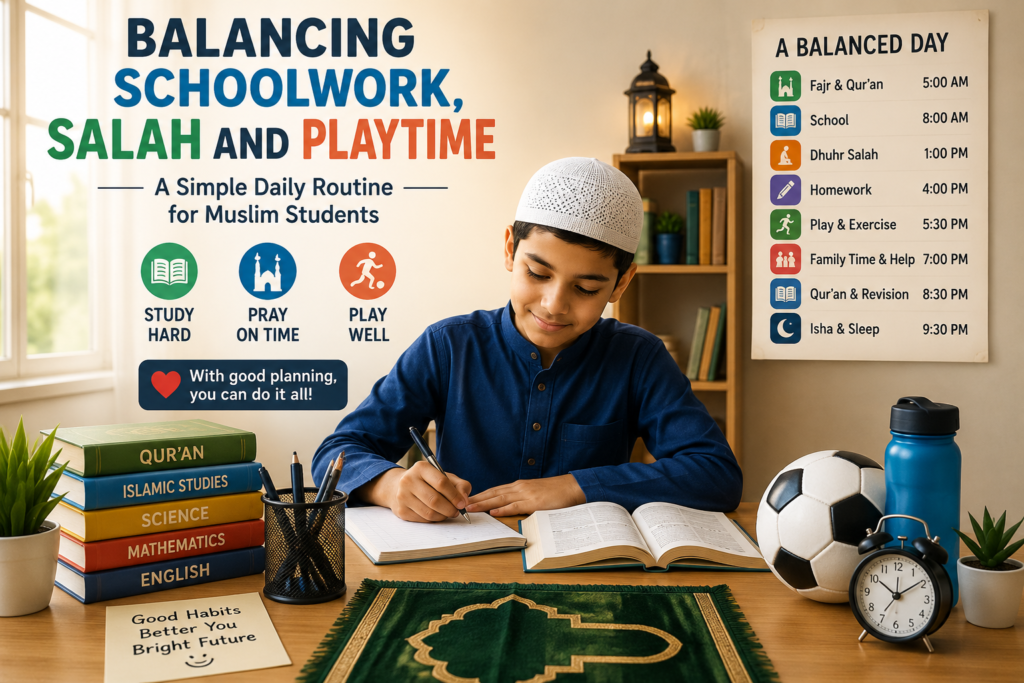
Have you ever wished there were more hours in the day?
School, homework, tuition, sports, chores, friends and Salah can sometimes feel like too much. Many Muslim students ask the same question: How can I manage everything without feeling tired or falling behind?
The answer is balance.
Islam teaches us to use our time wisely. We should work hard at school, pray daily, help our families and make time for healthy play. Each part of the day matters.
Here are some simple ways to balance schoolwork, Salah and playtime.
Start Your Day with Allah (SWT)
A good day begins with a good start.
Wake up in time for Fajr, thank Allah (SWT) for a new day and read a few verses from the Holy Qur’an if you can. Even five quiet minutes can help you feel calm and ready for school.
Before leaving home, say “Bismillah” and read the Du’a for travelling. These small habits remind you that Allah (SWT) is always close to you.
Also Read Growing With Adab: A Powerful Book for Muslim Teen Identity, Faith and Family
Do Your Best at School
Learning is an important part of a Muslim student’s life.
When you study with a good intention, your effort can become an act of worship. Listening in class, completing your work honestly and respecting your teachers are all signs of good character.
Try to finish as much work as possible during school hours. This can make homework easier later.
Plan Your Salah
Salah should not be forgotten when the day becomes busy.
Check the prayer times each morning. If Dhuhr falls during school hours, find out whether there is a clean and quiet place where you can pray. Some schools may have a prayer room or allow students to use an empty classroom.
If praying at school is not possible, perform Dhuhr as soon as you return home, provided the prayer time has not ended.
When it is time to pray, do not think, “I have to stop my work.” Think, “I can take a few minutes to remember Allah (SWT).”
Salah can calm your mind and help you return to your studies with better focus.
Finish Homework Before It Piles Up
Homework feels harder when it is left until late at night.
After returning home, have a short rest and a healthy snack. Then begin with the most important task. You can divide your work into small parts and take short breaks between them.
For example, study for 25 minutes, rest for five minutes and then continue. This can help you stay focused without becoming too tired.
Keep your books, timetable and school supplies in one place. A tidy study area can save time and reduce stress.
Check out: Relevant books
Make Time for Play and Exercise
Being a good Muslim student does not mean studying all day.
Children need movement, fresh air and fun. Playing football, cycling, swimming, running or enjoying a game with friends is good for both the body and the mind.
Play fairly, speak kindly and include others. Remember to stop when it is time for Salah, homework or family duties.
A healthy body can help you learn better and feel happier.
Help Your Family at Home
Your daily routine should also include small acts of help.
You can put away your school bag, set the table, tidy your room or help a younger brother or sister. These tasks may seem small, but they show kindness and responsibility.
Helping at home also gives your parents more time and makes family life easier.
Use Screen Time Wisely
Phones, games and videos can take up more time than we realise.
A few minutes can quickly turn into an hour. Set a clear limit for screen time and try to follow it. Finish your Salah, homework and chores first.
Use your free time to read, learn a skill, play outside or talk to your family.
Time is a gift from Allah (SWT), so use it carefully.
Also Read: The Path of the Caliphs – True Islamic Stories for Children (Ages 5–12)
A Simple Daily Routine for Muslim Students
Every family has a different timetable, but this example may help:
Morning
- Wake up and pray Fajr
- Read a little Qur’an
- Eat breakfast and get ready for school
- Leave home with “Bismillah”
During school
- Pay attention in class
- Be kind and respectful
- Pray Salah on time when possible
- Use breaks wisely
After school
- Rest and eat a healthy snack
- Pray when it is time for Asr and Maghrib
- Complete homework
- Play outside or exercise
- Help with a household task
Evening
- Prepare your school bag for the next day
- Read Holy Qur’an or an Islamic book
- Limit screen time
- Pray Isha
- Thank Allah (SWT) before sleeping
You do not have to follow this routine exactly. The aim is to give schoolwork, Salah, play and family time their proper place.
Tips for Managing Time Better
Try these simple habits:
- Write down your tasks for the day
- Complete the hardest work first
- Keep prayer times in mind
- Avoid using your phone while studying
- Prepare your clothes and school bag at night
- Go to bed on time
- Ask your parents for help when you feel overwhelmed
Small changes can make a big difference.
Also Read The Right Age to Introduce Islamic History to Children (and How to Do It Well)
What Does Success Really Mean?
Success is not only about getting the highest marks.
A successful Muslim student works hard, prays regularly, speaks kindly and uses time well. Good grades matter, but so do honesty, patience, respect and faith.
When you balance schoolwork, Salah and playtime, you can become more organised, healthy and peaceful.
You may not follow your routine perfectly every day. That is all right. Keep trying, learn from your mistakes and ask Allah (SWT) for help.
May Allah (SWT) bless your studies, accept your Salah and fill your time with knowledge, happiness and barakah. Ameen.