
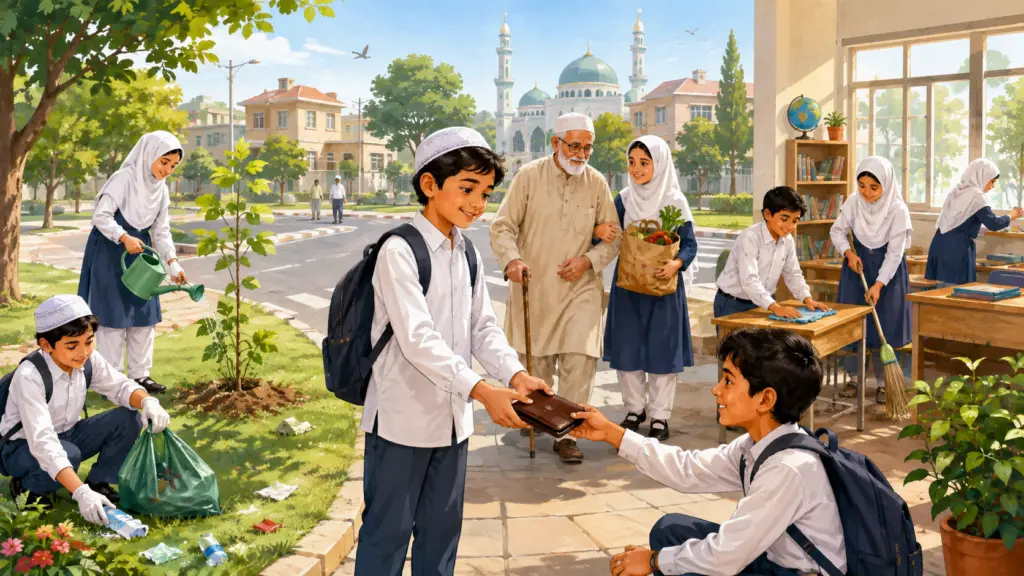
A country is more than a flag, a map or a national anthem. It is the place where people live, study, work, build families and share schools, roads, parks and neighbourhoods.
So, what does Islam teach about loving your country?
Islam does not ask Muslims to prove their love for a country only through slogans. It teaches something deeper: be honest, fulfil your responsibilities, help people, protect public property, act justly and contribute to the good of society.
In simple words, love for your country should be visible in the way you behave.
Did Prophet Muhammad ﷺ Love His Homeland?
Yes.
When Prophet Muhammad ﷺ was forced to leave Makkah, he expressed deep love for the city. An authentic narration records him saying that Makkah was beloved to him and that he would not have left had he not been forced to do so.
Later, after moving to Madinah, the Prophet ﷺ prayed:
“O Allah (SWT)! Make us love Medina as You made us love Mecca, or more.”
This narration is recorded in Sahih al-Bukhari.
These reports show that feeling attached to the place where we belong is natural. Islam does not ask people to live without roots or affection for their homeland.
Also Read Growing With Adab: A Powerful Book for Muslim Teen Identity, Faith and Family
A Good Citizen Is Trustworthy
Imagine finding a wallet in your classroom when nobody else is around.
What would you do?
For a Muslim, honesty does not depend on whether someone is watching.
Allah says:
“Indeed, Allah (SWT) commands you to return trusts to their rightful owners.”
The same verse also commands people to judge fairly. The Holy Qur’an 4:58 therefore connects trust with justice.
This has a direct link with good citizenship.
A student who refuses to cheat, a shopkeeper who gives the correct change, an employee who works honestly and an official who refuses a bribe are all helping society.
Honesty strengthens a country because trust strengthens a country.
Loving Your Country Means Helping People
You do not need to become a minister, soldier or famous social worker to serve your country.
Islam teaches that even small acts of public good matter.
Prophet Muhammad ﷺ taught that helping another person, speaking a good word and even removing something harmful from a road are acts of charity.
Think about what this means for a student.
You can:
- pick up broken glass from a playground;
- help an elderly neighbour;
- keep your classroom clean;
- save water;
- plant a tree;
- help a new student find their classroom.
Small acts can make a real difference.
The Holy Qur’an gives a simple rule:
“Cooperate with one another in goodness and righteousness.” — Qur’an 5:2
Good citizenship is not something you begin only when you become an adult. You can practise it today.
Check out: Relevant books
Islam Teaches Justice for Everyone
Loving your country does not mean thinking that people who look, speak or worship differently are less important.
The Holy Qur’an teaches that Allah (SWT) created people as different nations and tribes “so that you may know one another.” It also makes clear that true honour comes through righteousness, not race, nationality or ancestry.
The Holy Qur’an also teaches Muslims to deal kindly and fairly with people who live peacefully with them.
This is especially important in a diverse country.
A responsible Muslim citizen should treat classmates, neighbours and colleagues fairly, whether they are Muslim, Hindu, Sikh, Christian, Buddhist, Jain or follow some other faith.
Justice is not optional in Islam. Allah (SWT) commands justice, good conduct and fairness.
Does Patriotism Mean Agreeing With Everything?
No.
Loving your country does not mean pretending that everything is perfect.
Imagine that your school playground is dirty. Do you prove your love for the school by saying, “Nothing is wrong”?
Of course not.
You help clean it. You tell the right person about the problem. You try to improve it.
The same idea applies to citizenship.
A person can love a country while opposing corruption, injustice, discrimination, pollution or dishonesty. Wanting society to become fairer and better can itself be a form of responsibility.
The Holy Qur’an even tells believers not to let dislike of others push them away from justice.
So in Islam, citizenship is not blind loyalty. It is responsible loyalty guided by truth and justice.
Also Read: The Path of the Caliphs – True Islamic Stories for Children (Ages 5–12)
What Can Muslim Students Do for Their Country?
You may think, “I am only 11 or 14. What can I really do?”
Quite a lot.
You can:
- tell the truth even when lying seems easier;
- refuse to cheat in examinations;
- respect school and public property;
- avoid littering;
- save water and electricity;
- help neighbours and classmates;
- follow fair school and civic rules;
- refuse to bully someone because of religion, language, caste or background;
- verify information before forwarding it online;
- volunteer for useful community projects;
- study seriously so that your knowledge can benefit others.
These may look like small actions, but together they build a stronger society.
Why Honesty Matters in Citizenship
Prophet Muhammad ﷺ taught that truthfulness leads towards righteousness, while repeated lying leads in the opposite direction.
That makes honesty more than a personal virtue.
Honest students can grow into honest professionals. Honest professionals help build honest institutions. And honest institutions help create stronger countries.
This is why good citizenship begins with character.
Also Read How Muslim Students Can Balance Schoolwork, Salah and Playtime
So, Is Loving Your Country Islamic?
Yes. Love and attachment to one’s homeland are natural and compatible with Islam.
Prophet Muhammad ﷺ showed affection for Makkah and prayed for love of Madinah.
But Islam asks Muslims to turn affection into good character.
A Muslim does not serve the country only by waving a flag once a year. A Muslim serves society by being trustworthy when nobody is watching, fair when anger makes fairness difficult, helpful when someone needs support and responsible with the resources everyone shares.
That is a powerful way for students to understand patriotism.
Love your country by helping make it better.
Frequently Asked Questions
Does Islam allow Muslims to love their country?
Yes. Authentic narrations show Prophet Muhammad ﷺ expressing love for Makkah and praying for love of Madinah. Loving one’s homeland is natural and does not conflict with Islam.
Also Read: Introducing Faith with Kindness: Know Your Prophets for Young Readers
How can a Muslim student be a good citizen?
A Muslim student can be a good citizen by being honest, fulfilling responsibilities, respecting others, helping the community, protecting public property and standing for justice.
Does Islam teach Muslims to respect people of other religions?
Yes. The Holy Qur’an teaches kindness and justice towards people who live peacefully with Muslims and reminds humanity that different peoples and tribes were created so that they may know one another.
Is criticising problems in your country against Islam?
No. Loving your country does not mean ignoring injustice, corruption or other problems. Trying to improve society in a fair and responsible way can be part of good citizenship.